Better than synthetic hydrocarbons for cars and gas boilers: Energy storage and decarbonized cogeneration
Executive summary
- Decentralized short-term power storage next to small photovoltaic systems (home storage) could both avoid overload of local power grids and increase profitability of saesonal storage solutions or the production of synthetic hydrocarbons (synthetic methane or liquid e-fuels).
- If there will be no better way of seasonal storage than producing synthetic hydrocarbons, the most effective way to use them is definitely cogeneration, delivering on one hand electricity for electric cars, heat pumps and other electric devices, and on the other hand heat for district heating. The seasonal fluctuations of renewable energy generation are no argument to continue buying cars with internal combustion engines or to keep a gas boiler because both needs much more electricity to be generated and converted into synthetic hydrocarbons by expensive electrochemical plants than in case of using battery electric cars and heat pumps or district heating.
Furthermore I'd like to present two innovative solution approaches for technically and economically more efficient energy storage:
- Individual swappable batteries for electric vehicles that allow to leave a part of the battery capacity at home as a home storage as long as there is no long trip planned, requiring the maximum battery capacity
- Big high-temperature Carnot batteries, located in urban agglomerations for seasonal storage of heat in order to provide electricity and district heating during winter.
Definitions and compared alternatives
Decentralized short-term power storage (home photovoltaic energy storage)
These energy storage devices are directly connected to photovoltaic systems of the scale of the roof of a detached house. They are electrochemical batteries similar to those of electric cars, e-bikes, laptops or mobile phones. Such home storage systems are dimensioned for storing the photovoltaic electricity generation over several hours or days. Such buffering next to many small, disperse photovoltaic systems is particularly useful because in suburban and rural residential areas photovoltaic generation around noon in summer exceeds local power consumption by far, leading to overload of local power grids. Larger photovoltaic systems, e.g. on big parking areas or warehouses can be more easily connected to more performant power lines and electricity generated by photovoltaics on larger apartment or office buildings is to a larger extent consumed locally.Another advantage of private home storage systems is the possibility to maximise the share of the generated electricity that is consumed by the owner of the system instead of selling electricity to the grid and buying it back later. This increase of internal consumption is financially beneficial for the residents.
Individual swappable batteries for electric cars
"Swappable batteries" mean that a part of the battery capacity of an electric car isn't permanently connected but can be mechanically and electrically separated from the vehicle, e.g. by lifting or rolling the battery out of the vehicle or detaching a trailer. In contrary to previous concepts for battery swapping services, it is not (only) about replacing a discharged battery by a charged one during a long trip. The novelty of the proposed solution is that in daily use with usually lower range requirements the electric vehicle uses only a part of the maximum battery capacity while the remaining part stays at home serving as a home storage for photovoltaic power. Only in cases of longer trips, e.g. for vacations or long business trips, the electric car is equipped with the maximum battery capacity.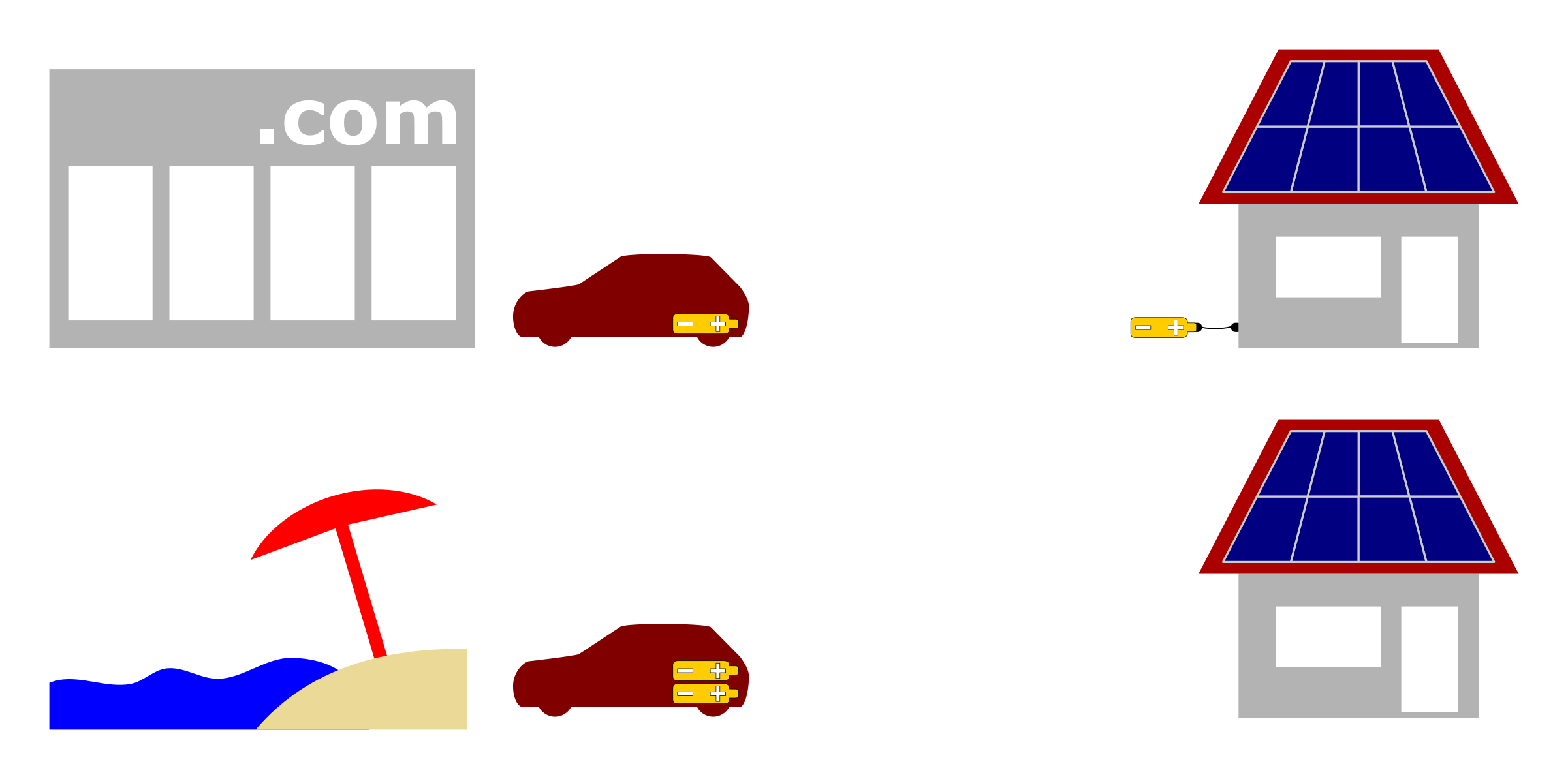
The target group of this solution are people living in an area of lower residential density but high potential for photovoltaics (e.g. residential areas consisting out of single-family homes) and commuting either directly into an urban area or to a park-&-ride facility. In such a situation, conventional electric cars with permanently installed batteries can hardly contribute to the relief of local power grids by reverse charging because around noon, when there is the maximum electricity generation by photovoltaics, these cars are not at home next to the photovoltaic system, but in a city or on a park-&-ride facility. Compared to other ways of reversed charging, leaving a part of the battery capacity at home has the advantage of avoiding additional contractual relationships between the car owner and different electricity suppliers buying and selling electricity at different time and locations. Instead, self-consumption is optimized and feed-in to the power grid is flattened.
Seasonal Carnot batteries
"Carnot battery" is a generic term for energy storage systems storing heat in order to convert that heat in case of demand by the use of a thermal engine (Carnot cycle or other thermodynamic cycle) into a (smaller) part of electric energy and a (larger) part of lower-temperature heat. A "seasonal Carnot battery" means a Carnot battery that is dimensioned to store heat over several months. In summer, the storage is charged using surplus electricity from photovoltaics. In winter, the storage is discharged, generating electricity to compensate missing photovoltaic generation and to power heat pumps and the waste heat of the thermodynamic cycle can be used for district heating. In order to store a big quantity of heat, the seasonal Carnot battery works with very temperature, achieved by the use of electric heating resistors. For minimizing the heat losses over long time, the heat storage is very big with massive insulation. Reconversion of high-temperature heat into electricity and heat for district heating is similar to a conventional cogeneration plant with the significant difference that the heat storage serves as the heat source of the cycle instead of gas burners. It would be an obvious option to establish such Carnot batteries by replacement or even reconstruction of existing urban cogeneration plants.Synthetic hydrocarbons: synthetic methane and e-fuels
"Synthetic methane" is chemically nearly the same as natural gas, but produced by the climate-neutral "power-to-gas" process. This means converting first electric energy (primarily from photovoltaics) into hydrogen by electrolysis and then producing methane by synthesis of hydrogen and carbon dioxide. Then, methane can be further converted into liquid hydrocarbons ("e-fuels"). In terms of energy efficiency it is important to differentiate between different ways of use of these hydrocarbons that are produced without fossil oil or gas:- There is no doubt that synthetic hydrocarbons as well as hydrogen will be used in the chemical sector and in metallurgy replacing mineral oil, natural gas and coal as raw materials.
- For aviation and potentially navigation for long time there won't be any other practicable energy carriers facilitating long range and in aviation also low weight.
- Similar to natural gas, synthetic methane can be used to power cogeneration plants, supplying electricity grids and district heating networks.
- From a purely technical point of view, synthetic methane can also be burned in a conventional gas boiler or gas cooking stove.
- From a purely technical point of view, e-fuels (synthetic liquid hydrocarbons) can be used for conventional cars with internal combustion engines.
Carbon-neutral cogeneration
I use the term "carbon-neutral cogeneration" for either a cogeneration plant powered by synthetic methane or for a seasonal high-temperature Carnot battery. Both works without fossil energy carriers (natural gas, mineral oil or coal) and generates as much electricity and useful heat but as little useless waste heat as possible. The only difference between these two solutions is the way of storing the energy between summer and winter.Comparison of efficiency
Efficiency criterion Nr. 1: Which amount of useful energy is generated from one kilowatt hour of photovoltaic electricity?
Details about references, assumptions and calculations are summarized in a separate document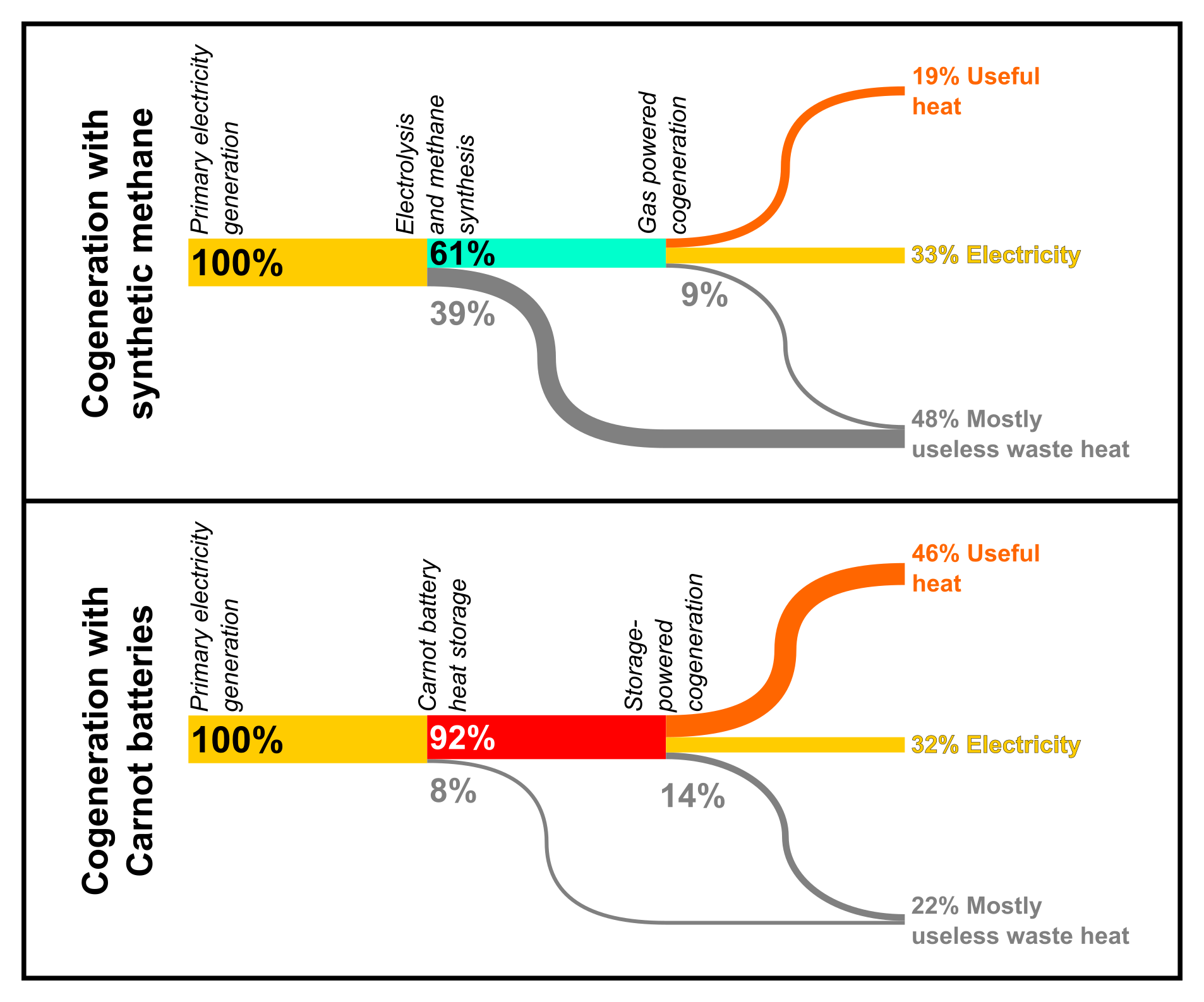
The comparison of energy efficiency between the use of Carnot batteries and cogeneration plants fuelled by synthetic methane shows a notable tendency in favour of Carnot batteries, but there must be still considered a big uncertainty about the achievable operational efficiency of Carnot batteries. In contrast to that uncertainty between these two ways of cogeneration (powered by heat storage or by burning synthetic methane), there is no doubt that any cogeneration is much more efficient than burning synthetic methane directly in gas boilers or using e-fuels for cars driven by combustion engine:
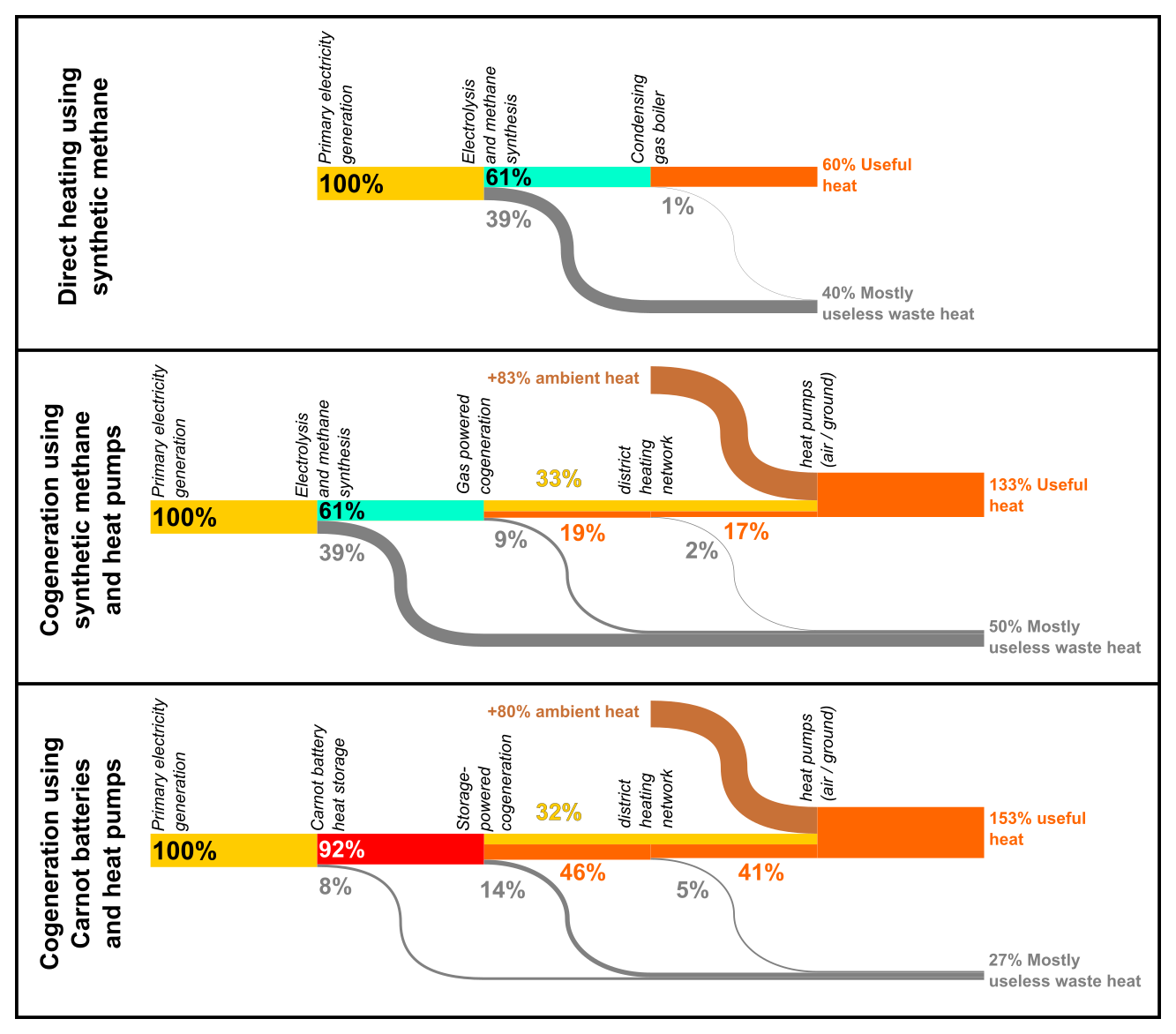
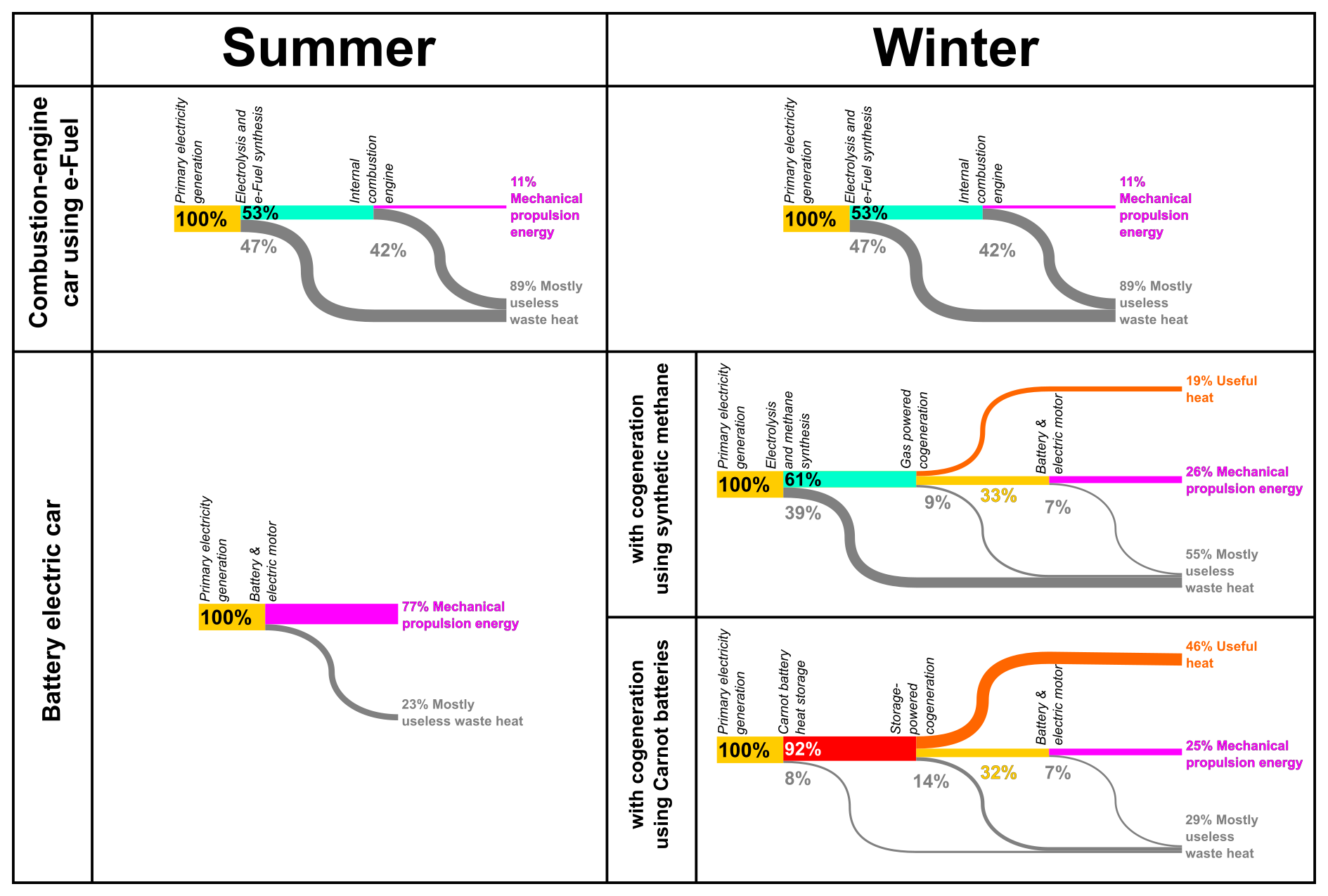
Efficiency criterion Nr. 2: steady utilization of expensive plants
Another efficiency criterion is the time course of the utilization of infrastructure and energy conversion plants. It can be well measured by full load hours per year, calculated by dividing the amount of energy, processed per year (in kWh - kilowatt-hours or MWh - megawatt-hours) by the maximum possible power of the plant (in kW - kilowatt or MW - megawatt). A hypothetical plant operated totally steadily would have 24 x 365 = 8760 full load hours per year. The yield of photovoltaic systems in central Europe is quite concentrated to the summer season and the hours around noon, usually they achieve about 1000 full load hours per year. As more and more photovoltaic systems are installed, in particular small ones on the roofs of single-family homes, there are increasing problems with overload of local electricity grids. These had been designed to supply households of moderately volatile demand, but not to collect a big total of power input from many homes at the same time. Without application of energy storage technology, more widespread installation of small photovoltaic systems leads to the necessity of enormous investments in comprehensive improvements of the electricity grids from the local to the international level. The application of inefficient energy technologies like e-fuels or the use of synthetic methane for gas boilers would increase the demand for photovoltaic electricity and thus increase the demand for investments in electricity grids even more.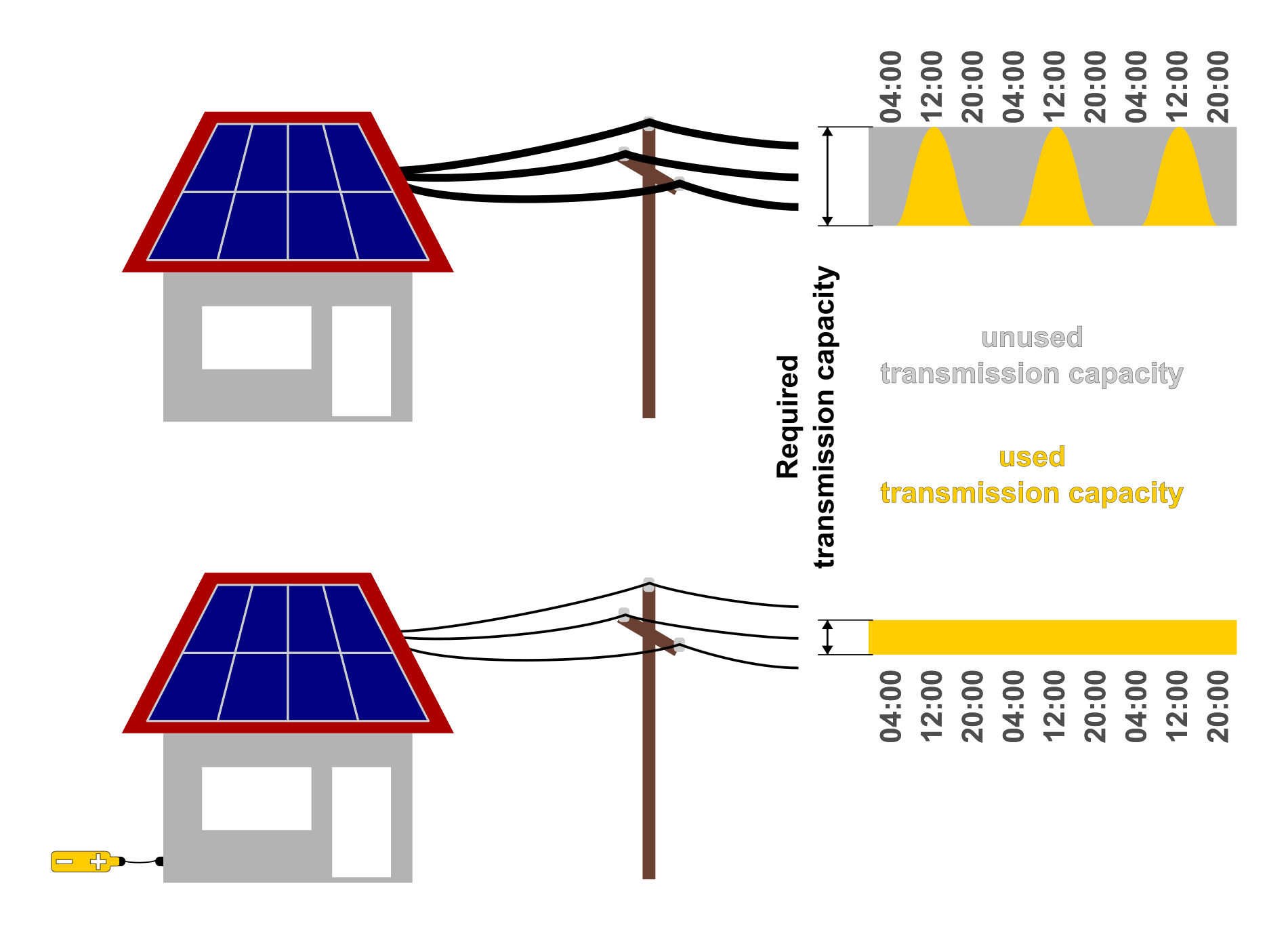
Uneconomic temporal utilisation characteristics can concern not only electricity grids: If most of photovoltaic surplus generation would be used for production of e-fuels and synthetic methane, these energy conversion plants would also have very few full-load hours per year. It would be necessary to dimension these plants for the electricity surplus of summer noon peaks, but even in summer, most hours of the day they would by far not be fully utilized. This would heavily affect the profitability of these plants, which are still just in a phase of development and require expensive, rare materials like platinum or palladium for electrodes and catalytic surfaces. The demand for these plants and materials can be significantly reduced if synthetic methane and other synthetic hydrocarbons are produced only to the extent required in the chemical sector, for navigation and for aviation and if photovoltaic electricity generation is additionally buffered by decentralized storage for some hours and by big Carnot batteries for months:
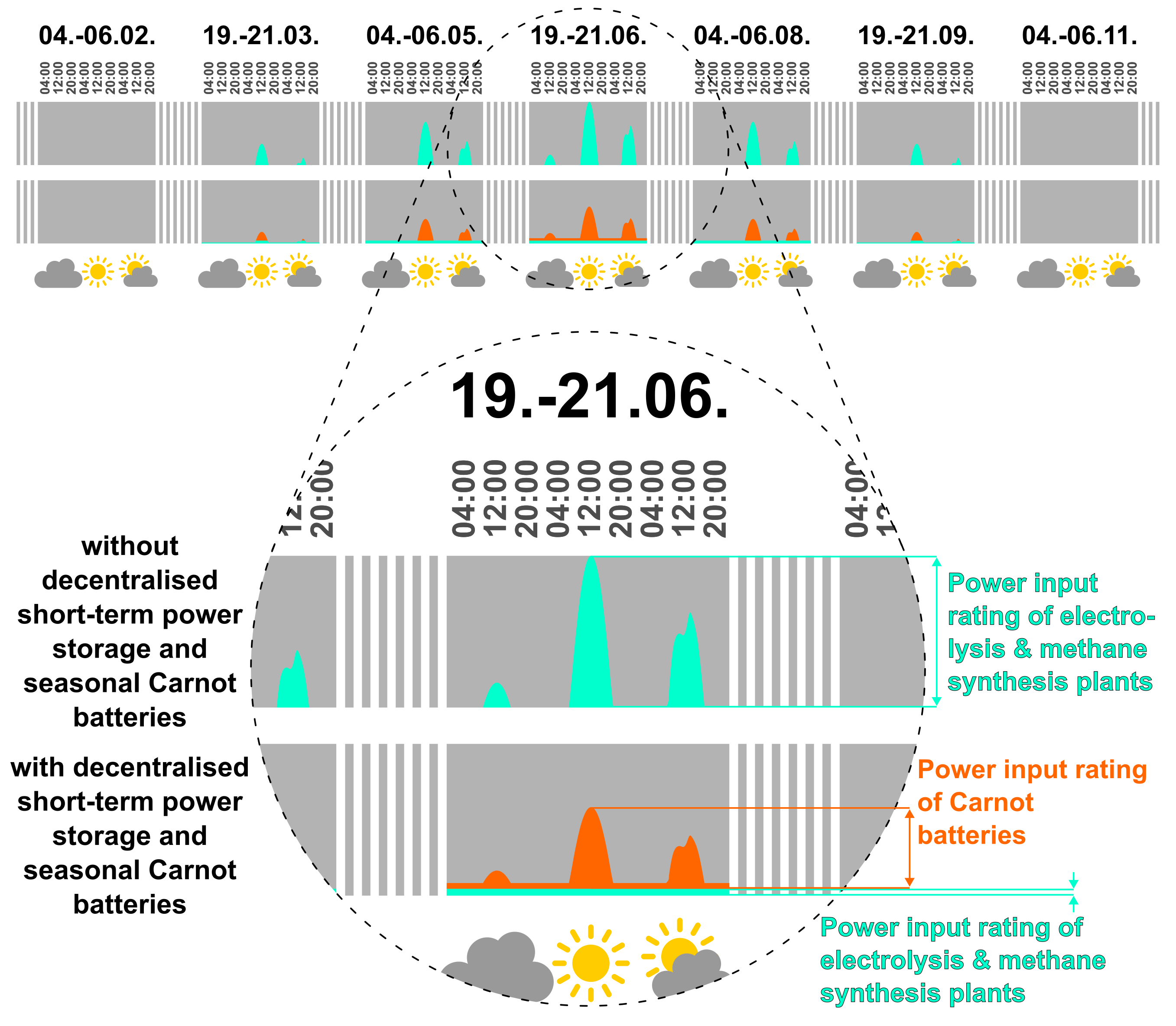
- First, already the local buffering of a part of the photovoltaic electricity generation, in particular that from the roofs of single family homes, leads to a much more steady utilization of either plants for production of synthetic hydrocarbons or Carnot batteries during (summer) days.
- Apart from small photovoltaic systems, spread over residential areas and buffered by decentralized energy storage, there will still much other sources of photovoltaic electricity, e.g. on multi-storey residential or business buildings, on warehouses etc. or as solar farms directly on the ground. Futrhermore, not every day during summer is sunny, so there is not just volatility during the day, but also from day to day. Additional volatility in energy generation originates from wind and hydropower and demand is volatile too. Because of all these factors, there will remain significant fluctuations in surplus electricity despite the use of decentralized buffer storage. In this context, Carnot batteries and electrochemical plants for the production of synthetic hydrocarbons complement each other very well: In relation to the input power, the heat resistors in a Carnot battery are much cheaper than the electrodes and catalysts for the production of hydrogen and synthetic hydrocarbons. Therefore, it is economically better to use photovoltaic peak generation surplus targeted for heating up of Carnot batteries, accepting very few full load hours per year for this part of the Carnot battery. This allows on the other hand to operate the expensive electrolysis and hydrocarbon synthesis plants steadily at least during the summer season.
Individual swappable batteries for electric cars
Previously intended use case: battery swap for range extension
All previous battery swapping systems are based on the idea of an electric car without or with just a small own battery and the exchange of uncharged by charged batteries during long trips. Battery swapping is much faster than recharging a battery, leading to the unique selling proposition of battery swapping services that it is neither necessary to equip the own vehicle with a very large battery nor to stop several times for long charging procedures during long trips. This creates the added value of battery swapping systems of either reduced costs and resource consumption for battery capacity (compared to a conventional electric car with long range) or shorter travel time because of the eliminiation of charging stops (compared to a conventional electric car with short range).
Proposed additional use case: swappable batteries as (mostly) stationary storage for photovoltaic electricity
The idea of "individual swappable batteries" has another purpose: The required battery capacity is the same as for a conventional electric car, but the battery capacity is much better utilized: That part of the battery capacity that is required just some times per year for long trips stays at home for the rest of the year and serves during sunny summer days as a stationary energy storage: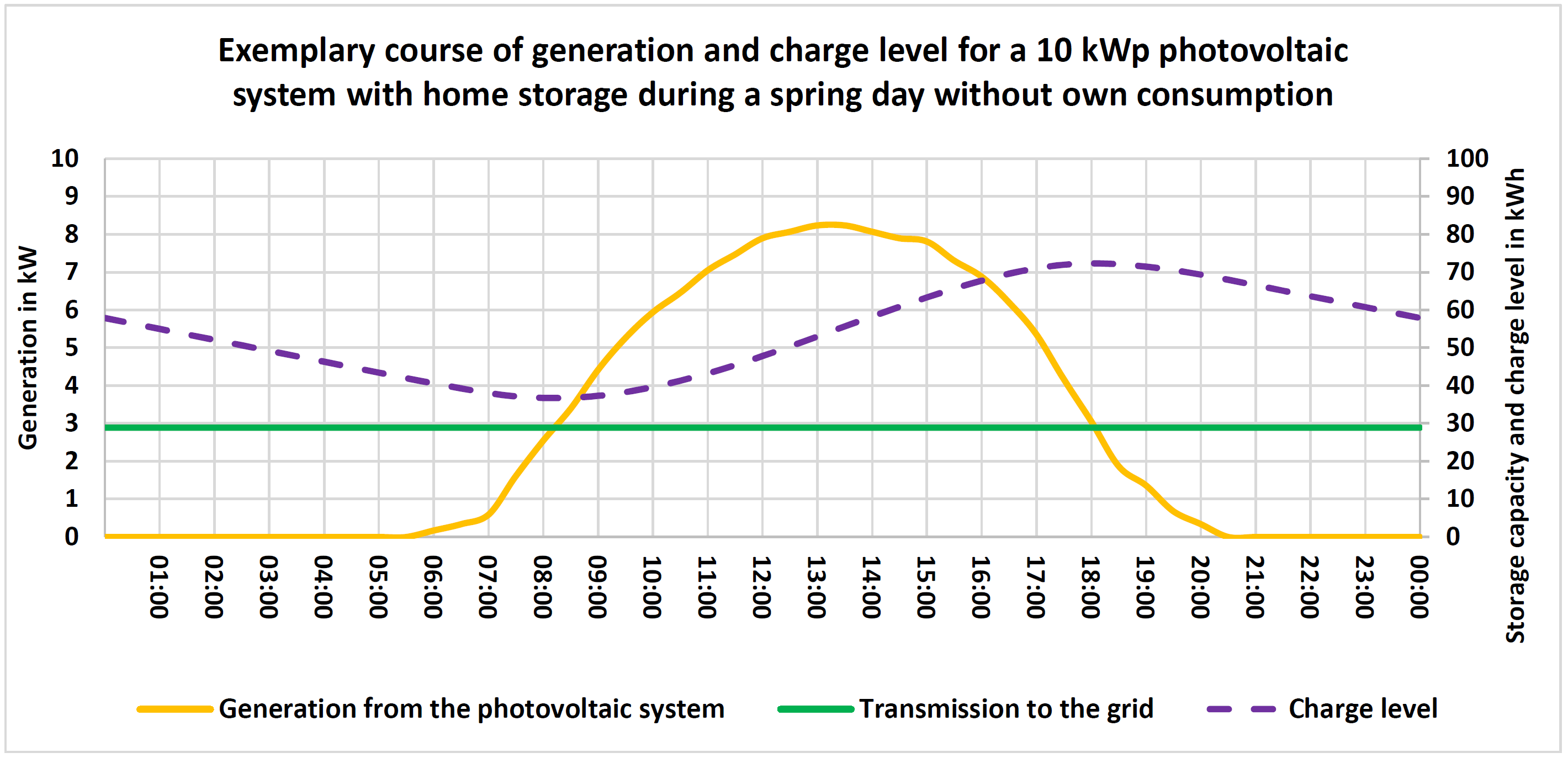
This new use case for battery swapping systems isn't contradictory to the previously promoted use cases of batter swapping services, they can be well combined:
- Inhabitants of single family homes with photovoltaic system own a swappable battery. They use them most of the time as a stationary energy storage and sometimes as a part of their electric car in order to extend the range for longer trips
- Owners of electric cars living in a flat or in a home without photovoltaic system have no own swappable battery but rent one from a battery swapping station when they need more range as covered by the battery permanently installed in the car.
- Users, that own a swappable battery can still rent one if the need for a longer trip emerged unexpectedly and there was either no time to come home for the battery or it wasn't fully charged at that moment.
- A rented swappable battery running empty during the trip can always be replaced by a fully charged rental battery. More complicated is just the case if the own swappable battery should be replaced by a rented one because the rented one could be in a better or in a worse state than the own one.
Previous entrepreneurial attempts and applied technical solutions
The following previous battery swapping service projects should be mentioned:- "Better Place" was an early company developing a battery swapping service with big, automated swapping stations with a robotic mechanism exchanging the battery mounted in the car bottom from beneath the car. The company was started in 2007 but went bankrupt in 2013.
- EP Tender is a company developing swappable batteries in the form of trailers. The vehicles are still permanently equipped with a smaller battery and in case of demand for longer trips, a battery trailer is available for rent.
- The battery capacity of the XEV Yoyo light electric vehicle is divided into three single batteries. With a weight of 25 kg it is hard, but possible to carry them. A petrol station chain offers the exchange of discharged for charged batteries, using a mobile rack for the sake of employee protection.
New ideas: Swappable batteries as a part of a modular vehicle concept or for retrofit of internal combustion engine cars
In addition, I'd like to present two own ideas, how the advantages of swappable batteries could be combined with further side benefits:- The modular puzzle car, consisting out of a base unit with two seats, motor, steering and a part of the battery capacity, an additional battery unit and an additional seats unit:
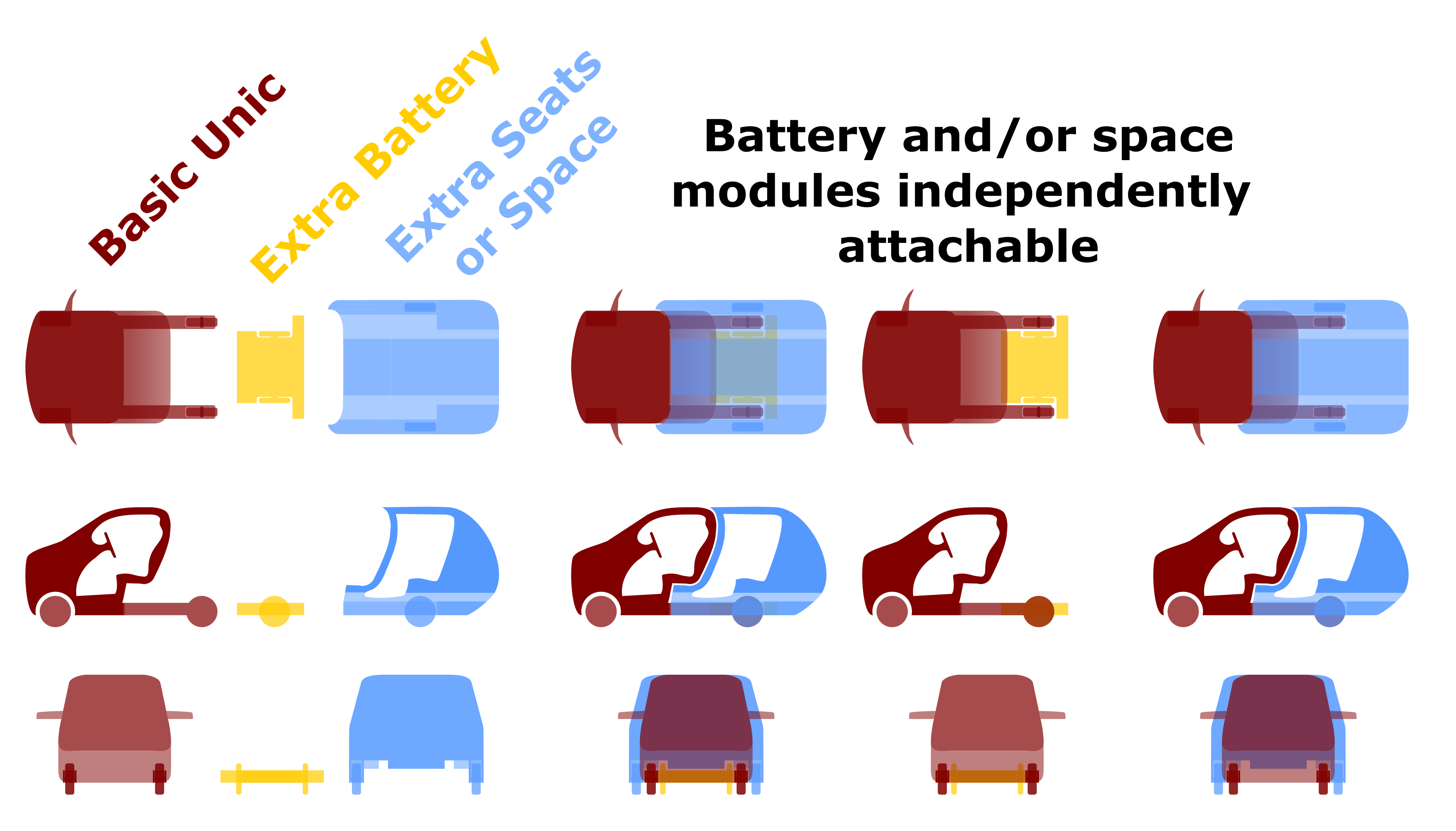 As described above, the battery unit can be used as an individual swappable battery for stationary energy storage or as a swappable rental battery for longer trips without breaks for charging. The additional seats unit allows the users to make either use of the capacity of a standard passenger car or the advantages of a very small vehicle like low electricity consumption and parking space requirement. Families can operate very flexibly with two base units and one additional seats unit. Other additional units, e.g. with cargo space or a caravan unit are conceivable as well. As a special feature of this solution, the four-wheel base unit and the two-wheel additional units fit together in a way that any configuration is a rigid vehicle with two to six rear wheels parallel aligned. This means that from driver's perspective, the vehicle behaves like an ordinary rigid car and in contrary to battery trailers, there are no special driving skills needed at all.
According to the proportions in the drawing, the available volume for a battery module is about 150 l, corresponding to a capacity of roughly 50-55 kWh as a lithium ion battery or about 20 kWh as a sodium ion battery. According to the electricity consumption of a typical electric compact car, this means a range of about 330 km (Li-ion) or 130 km (Na-ion). In addition, the base unit contains a permanently connected battery granting some moderate range for daily trips without using an additional battery module.- The roller-style battery system for the conversion of internal combustion engine cars: the conversion of cars with internal combustion engines into electric cars would be more ecologically more sustainable and in case of sufficient lot sizes economically efficient too. Unfortunately, cars converted to electric drive achieve only short range because of the conversion must not lead to significant weight increase. This is why it would make sense to combine the conversion from internal combustion to electric engine with a battery swapping solution. A solution approach that is suitable for many different car body shapes is based on a larger number of roller-shaped batteries and something similar to a marble run toy both inside the vehicle and inside the battery swapping station:
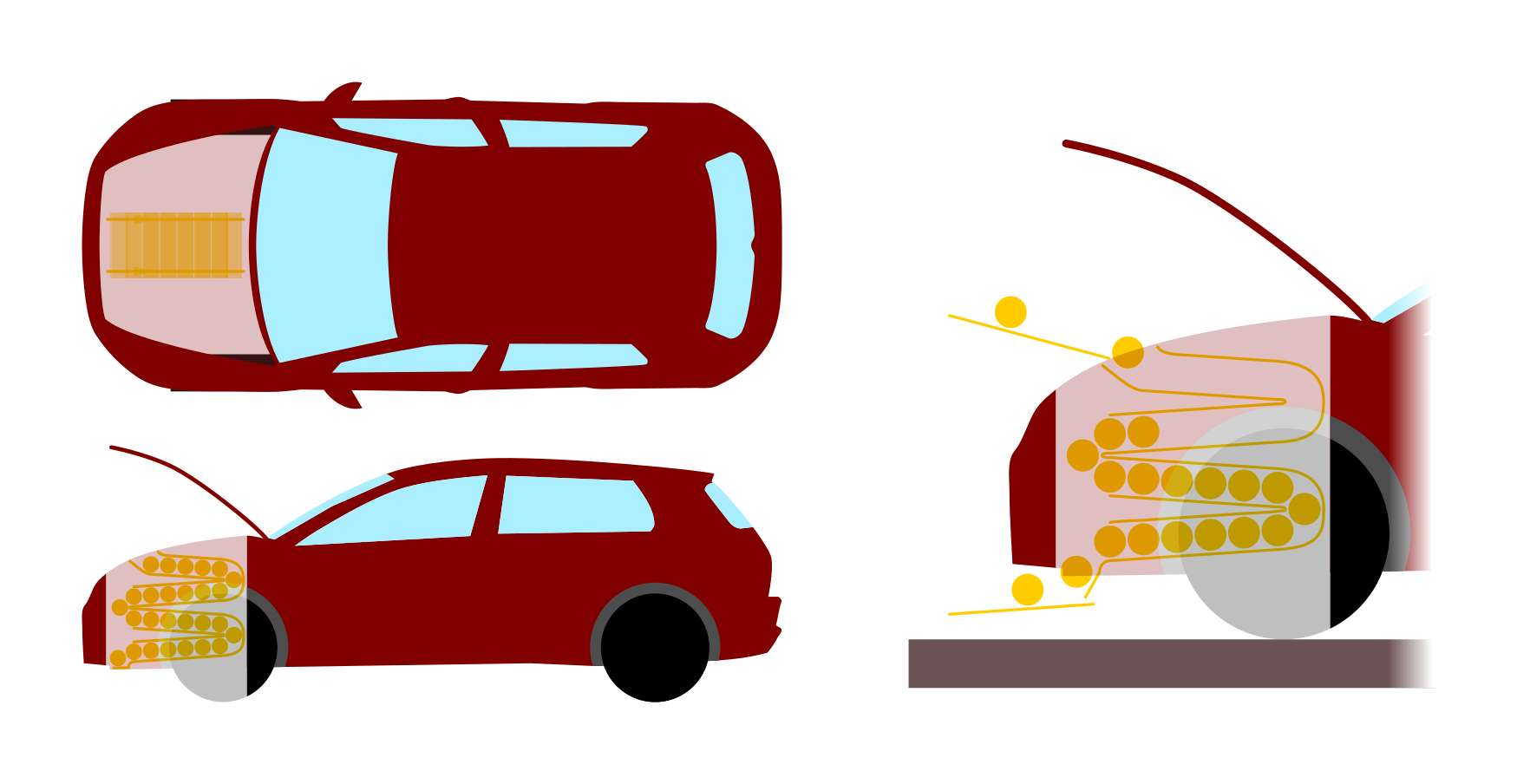 The proportions in the drawing correspond to a battery diameter of 10 cm and a battery length of 40 cm, the outline of the vehicle represents a Volkswagen Golf VII. The 27 roller-shaped batteries correspond to a total capacity of about 30 kWh or a range of roughly 200 km in case of lithium iron batteries. The maximum battery capacity to be accommodated in the vehicle is rather not limited by the volume of the former engine compartment, but by the weight: 27 batteries of 10 cm diameter and 40 cm length have a total weight of about 200 km, similar to the weight of the removed internal combustion engine. The load on the car body could eventually be further reduced by the use of in-wheel motors. An additional battery could be permanently installed instead of the fuel tank. If the vehicle weight shall be kept, a typical 50 l fuel tank could be replaced by a battery of about 8 kWh (Li-ion), representing a range of about 50-55 km. Additional permanently installed battery capacity might be feasible at the expense of the payload of the car.
The weight of each roller-shaped battery would be about 7,5 kg. Public battery swapping stations should be designed as a highly automated design with the discharged batteries rolling out of the vehicles at the bottom and charged batteries rolling into the vehicle from the top. A similar mechanism could be installed in private garages as well, but users that move the roller-shaped batteries just several times per year between the home charging station and the car can do this manually as well.Centralized, seasonal high-temperature Carnot batteries
Wikipedia, a much more comprehensive summary of different types of Carnot batteries is the paper "Review of Carnot Battery Technology Commercial Development" by Václav Novotný et.al..State of the art
The different solution approaches developed until now differ by:- Heat generation: heat can be either generated directly (ohmic resistor) or by a heat pump.
- Heat storage, roughly differentiated between "sensible heat storage", storing heat proportionally to the temperature difference or "latent heat storage", absorbing or returning heat at nearly constant temperature through melting/solidifying or other changes of physicochemical properties.
- Reconversion of heat to electricity by different types of thermal engines like gas turbines, steam turbines or Stirling motors.
Demand for seasonal electricity storage
In the light of the state of the art and political developments related to energy issues, a high demand for practicable and cost-efficient solutions for seasonal electricity storage is expectable. Photovoltaic electricity generation grows much faster than wind power despite the fact that the former is extremely concentrated to the spring and summer season whereas the latter is rather effective during winter. Wind power as well as additional or upgraded high-voltage lines often face (unjustified) opposition from neighbouring residents, long approval procedures and poor political support, regardless to the fact that many wind turbines and performant power grids would probably be the most cost-efficient way to provide reliable carbon-free energy supply during autumn and winter by balancing electricity generation and demand between areas of different weather conditions. On the demand side, there is a positive tendency towards more heat pumps instead of gas or oil boilers, but also to the use of less efficient air heat pumps instead of the more efficient geothermal or groundwater heat pumps. At the same time, there is still insufficient progress concerning thermal insulation of buildings. Both is rather not a question of the investment necessary for increased energy efficiency, but of administrative effort and organizational difficulties, e.g. if a joint decision of many apartment owners is required. Both the high share of photovoltaics in electricity generation and the increased electricity demand for heat pumps increases the need for seasonal electricity storage. Massive construction of further hydroelectric storage plants seems unrealistic concerning suitable sites, land use and nature conservation requirements. Until now, the only widely discussed technical solution is the production of synthetic methane and its reconversion into electricity and district heating. Unfortunately, it is still very questionable when and at what cost this technology will be applicable to what extent. Therefore it makes sense to develop in parallel another solution: the seasonal Carnot battery.Conceivable characteristics of a seasonal Carnot battery
The main challenge of Carnot battery that shall be charged in summer and discharged in winter is the storage of a large quantity of heat with low loss over long time. In return, a seasonal Carnot battery has the advantage that decharging in winter can perfectly follow the principle of cogeneration of electricity and district heating.
This leads to the following attributes:- Very high temperature level of the storage in order to store more heat per storage volume
- Charging by simple ohmic resistors, because they are cheap and heat pumps are unsuitable for that high temperature anyways
- Concentration of the storage capacity to a rather few number of big, centralized plants: the storage capacity increases with the volume of the storage, the heat losses (at same insulation thickness) only with the surface. This means, that doubling length, width and height of a storage cuts the losses in relation to the storage capacity by half. Furthermore, in case of bigger storage units, it is easier to reduce heat losses by increasing the insulation thickness without losing significantly storage volume.
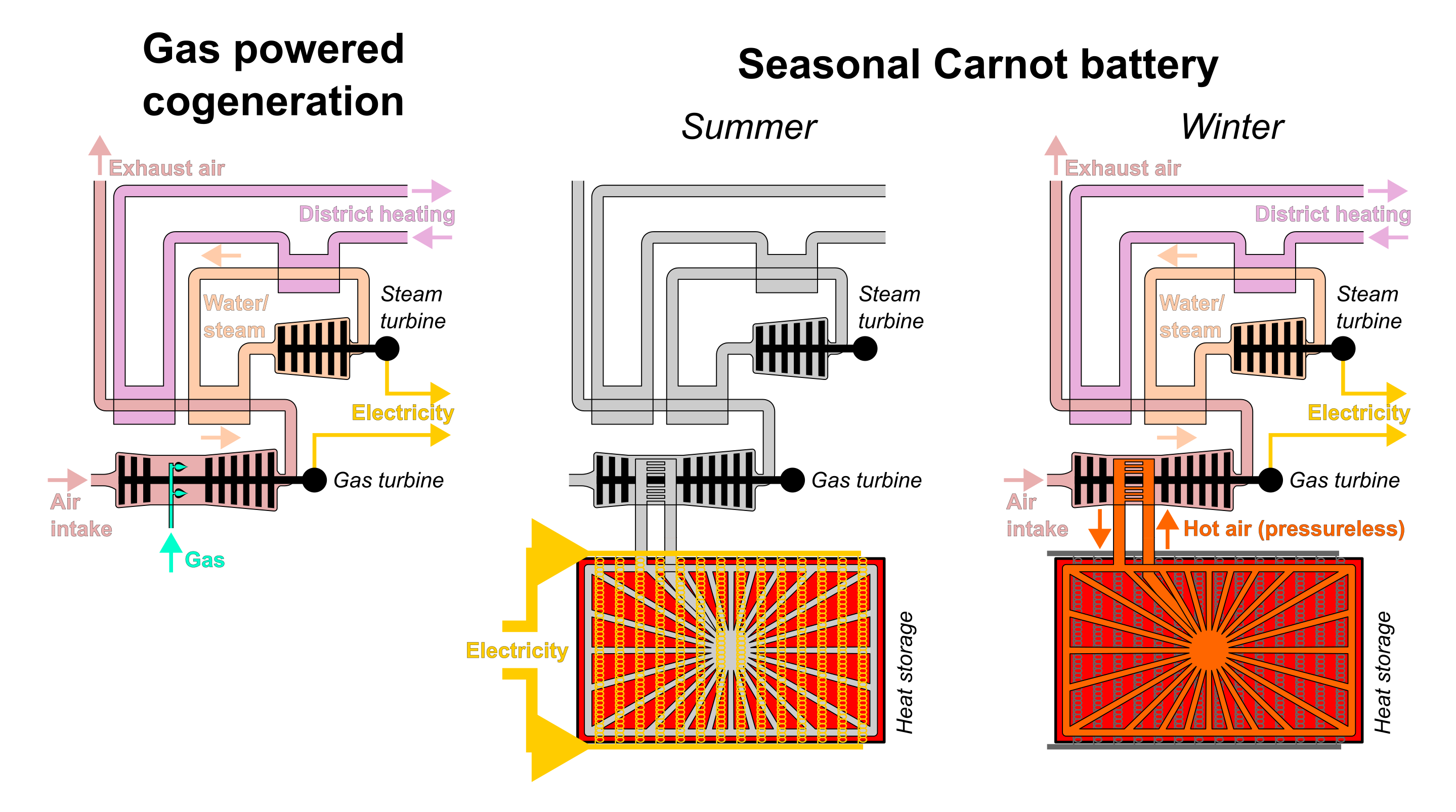 Carnot batteries as large, centralized plants would fit well to existing structures: They could replace existing, natural gas powered cogeneration plants. The similarity between storage powered and natural gas powered thermodynamic cycles might even allow to reconstruct existing gas powered into storage powered cogeneration plants. Existing cogeneration plants at the outskirts of big cities are optimally integrated in both electricity grid and district heating networks.
A plant of relatively similar characteristics except size and storage duration has been examined within the "High-T-Stor" project by the Universities of Applied Sciences Mittelhessen. The heat storage unit of this project is nearly a cube of about 2,4 m side length and consists out of ceramic bricks which can be heated up to 1200 °C, the insulation layer is about 60 cm. This storage looses roughly 5% of the stored heat per day. For reconversion of heat into electricity, a gas turbine cycle with external heating is applied: Air is blown through the heat storage and the heat from that air is transferred to the compressed air of the gas turbine cycle by a heat exchanger. Introducing compressed air or steam directly into the heat storage wouldn't be manageable from a process engineering point of view. Waste heat of this gar turbine cycle is used for district heating.
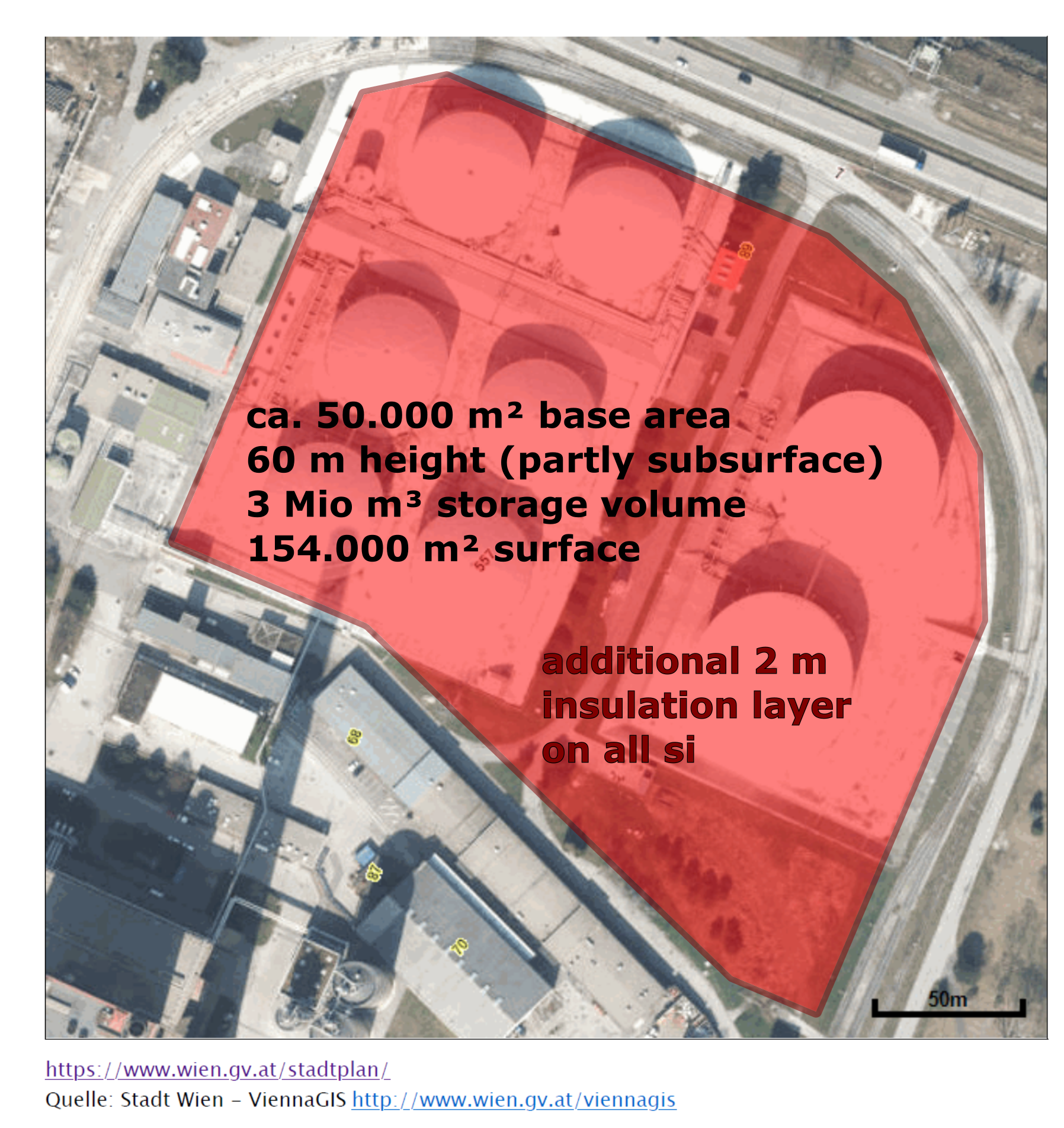 The following calculations are based on the idea to use the area next to the combined-cycle power plant Vienna Simmering, until now occupied by fuel tanks, for a 60 m high, partly underground heat storage (see aerial image). If the same storage material is used as in the "High-T-Stor" project and insulation is reinforced sufficiently in order to reduce the heat loss per surface area by half (approximately 2 m insulation layer), the heat losses are reduced to 0,02% per day. Considering that the storage never cools down completely and the average storage duration is 210 days, in regular operation 8% of the stored heat is lost through the surface of the storage.
Combined cycle gas power plants can achieve more than 60% electrical efficiency without district heating. A maximum utilization of the burned fuel is possible when using waste heat for district heating with 54% electrical efficiency and 31% of the energy input used district heating, leading to a total loss of only 15%. In case of a combined cycle process based on a heat exchanger powered by heat storage, the expected electrical efficiency is lower because the temperature of the storage is lower than that of a gas burner. An estimation according to the Carnot theorem results in an electric efficiency of the heat storage powered combined cycle of about 35%. In case of an unchanged total efficiency of 85%, the share of heat from the storage that is converted into useful heat for district heating is about 50%.
Some detailed aspects at the end
Why don't you mention biomass?
Why don't you mention hydrogen?
Hydrogen that isn't consumed or processed to synthetic hydrocarbons shortly after its production must be stored intermediately. Storing hydrogen requires much more effort for liquefaction or extreme compression than storing methane or liquid hydrocarbons. Furthermore, cogeneration plants and pipelines need technical adaptations in order to work with hydrogen, whereas synthetic methane can be processed by the same plants and pipelines as fossil natural gas.Why to you consider the heat losses from electrolysis and production of synthetic hydrocarbons as useless waste heat?
Heat losses from electrolysis inevitable occur exactly at the time of reliable energy overflow, during summer. If hydrogen isn't stored intermediately, the same applies for hydrocarbon synthesis. Despite there is some use for low-temperature heat during summer as well (e.g. water heating or industrial drying processes), there isn't really need for the use of further waste heat as solarthermic heat (thermal solar collectors or hybrid collectors) or waste heat from cooling and air condition processes are easily available.What about using conventional electric cars as buffer batteries on park-&-ride facilities with photovoltaic roofs?
That would be possible, but anyways these cars wouldn't contribute to the relief of local power grids in residential areas with many small rooftop photovoltaic systems. Larger, more centralized photovoltaic systems as e.g. on park-&-ride facilities can be more easily connected to the medium or high voltage grid or directly to the catenary or third rail of the respective railway or subway. Furthermore it would require the commuters to connect and disconnect their cars to a charging station on the park-&-ride facility every day and clearing about consumed, stored and resold electricity becomes more complicated.Would it be possible to import e-Fuels and synthetic methane from equatorial desert states?
From a technical point of view yes, but in practice nearly all suitable countries are authoritarian or fragile states. There is no reliable instrument to make such developments happen there and it would by geopolitically anything but reasonable to make us again dependent on such energy suppliers.
Aren't there any alternatives to such high effort for energy storage technology?
Yes, from a technical and energy-economical point of view in particular the following solutions could diminish the demand for energy storage:- Reduction of heat demand by insulation (thermal rehabilitation) of buildings
- Increased deployment of most efficient heat pumps (e.g. floor heating instead of radiators, geothermal or groundwater heat pumps instead of air heat pumps
- Reduction of the energy demand for mobility by more use of public transport, cycling, walking and light electric vehicles
- More load control (automatic switching on or off certain electricity consumers depending on available renewable energy)
- More use of wind power
- Reinforcement of power grids
- Construction of tidal power plants
References and assumptions in a separate document
- The roller-style battery system for the conversion of internal combustion engine cars: the conversion of cars with internal combustion engines into electric cars would be more ecologically more sustainable and in case of sufficient lot sizes economically efficient too. Unfortunately, cars converted to electric drive achieve only short range because of the conversion must not lead to significant weight increase. This is why it would make sense to combine the conversion from internal combustion to electric engine with a battery swapping solution. A solution approach that is suitable for many different car body shapes is based on a larger number of roller-shaped batteries and something similar to a marble run toy both inside the vehicle and inside the battery swapping station: