deutsch

Honeycomb-shaped photovoltaic system for transport infrastructure

Basic principle

The most important component of the modular construction system is a regular hexagon as a carrier element for photovoltaic panels. Larger constructions above transport infrastructure can be composed out of several hexagons. Hexagons can be rotated in 60° steps without changing the position of the pillars, in addition there are two mounting positions for the panels on the hexagons, differing by 90°. This means, that the orientation of the panels can be adjusted in 30° steps and the panels will never deviate from optimum orientation to the south by more than 15°:

Furthermore, there is a structural advantage as supporting structures composed out of hexogonal elements are more stable than such composed out of rectangles as there are no continuous joints through the surface.

This flexible panel arrangement facilitates universal application of the proposed modular photovoltaic system regardless to the orientation of the transport infrastructure to be covered and allows for mass production as well as for a routine construction procedure on site.

Concrete dimensions and adjustment to the standard panel size and different latitudes
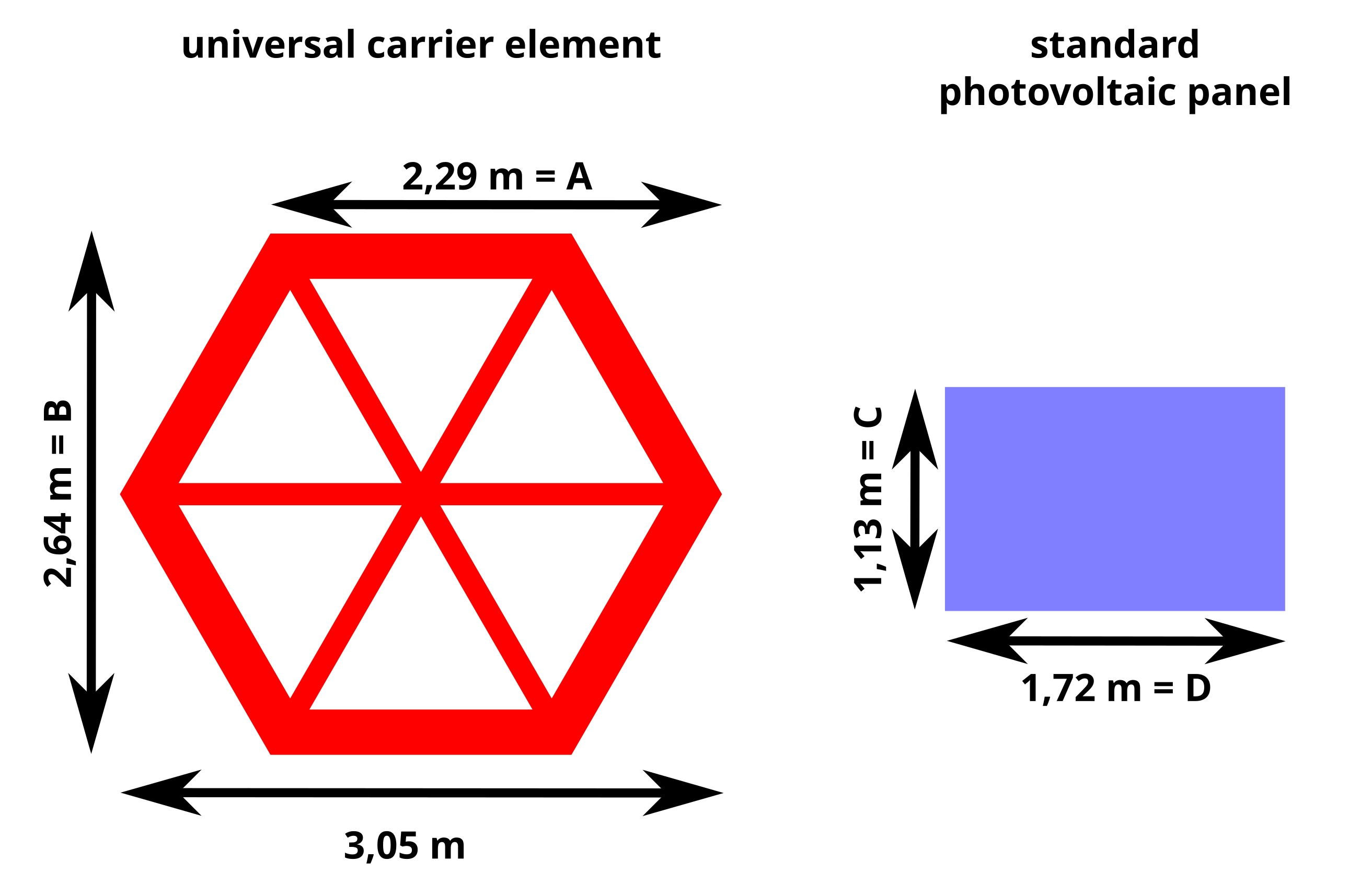
The proposed width between two parallel sides of the carrier elements is 2,64 m. This is too much for horizontal transport on a truck, but these hexagons can be accommodated vertically in a high-cube container or swap body. Exceeding the standard road vehicle width of 2,5 m is advantageous for application on carports, parking lots etc. with a common spacing of 2,5 m of passenger cars.

In order to achieve a manageable number of attachment points on the hexagon, the relationship between the spacing of the panels and the spacing of the hexagons shall be a fraction with a low numerator and a low denominator, so the positions of the panel on the hexagons will repeat after a reasonable number of panels and hexagons.

In the east-west axis, there are very simple relationships regardless of the latitude:

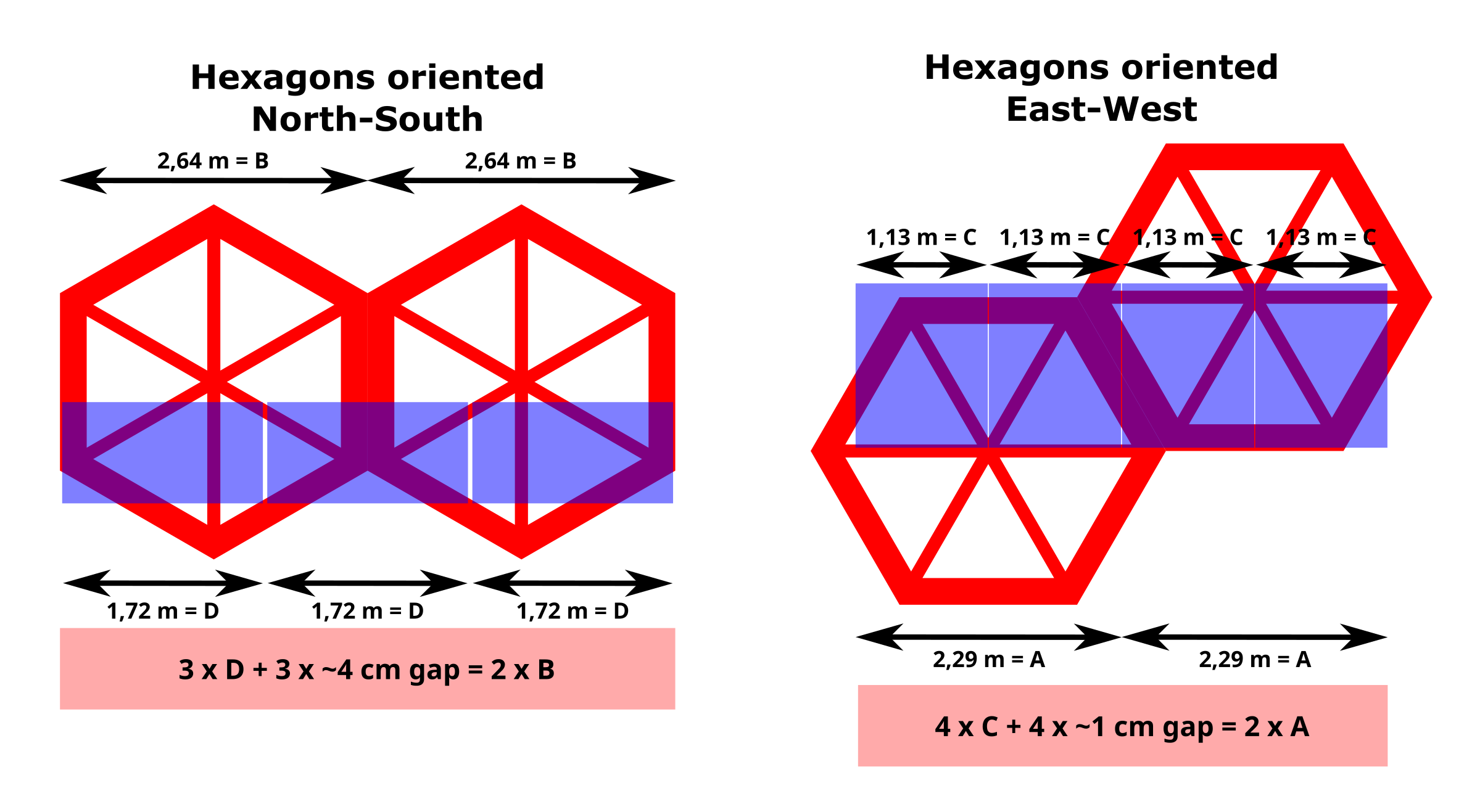
  • If two edges of each hexagon are north-south oriented, the standard-sized photovoltaic panels (1,72 x 1,13 m) are aligned by their longer edge in east-west direction. With a roughly 4 cm gap between the panels, three panels fit to two hexagons.

  • If two edges of each hexagon are east-west oriented, the standard-sized photovoltaic panels (1,72 x 1,13 m) are aligned by their shorter edge in east-west direction. With a gap of about 1 cm between the panels, the hexagon spacing is twice the panel spacing.
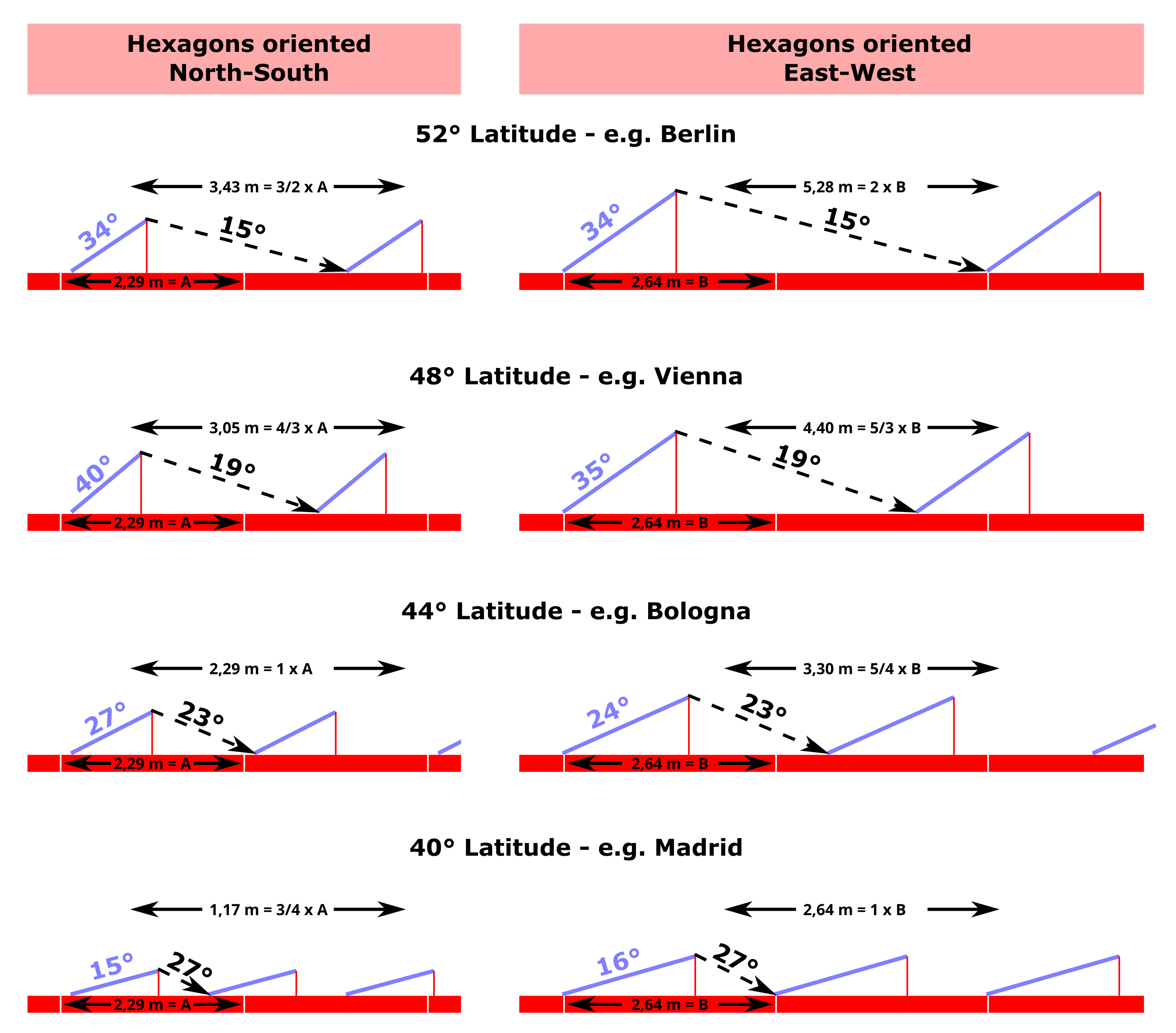
Along the north-south axis, the relationship between panel spacing and hexagon spacing depends on the latitude: The following two figures show combinations of panel inclination and panel spacing for different latitudes in Europe and for both orientations of the panel (short or long edge in east-west direction). With these combinations, there will be noch shadow of one panel on the next one even during the lowest solar altitude angle in late december at noon. Furthermore, for the two more northern examples, the minimum panel inclination is 30° to let snow reliably glide off the panels and to achieve more yield in winter.
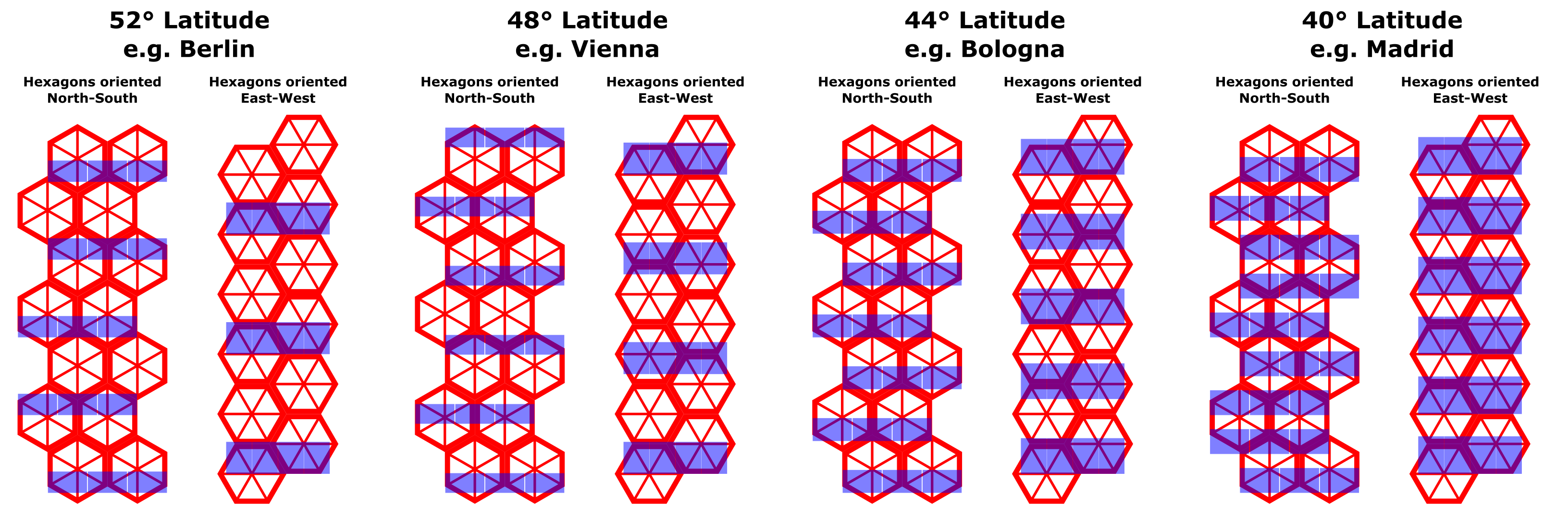
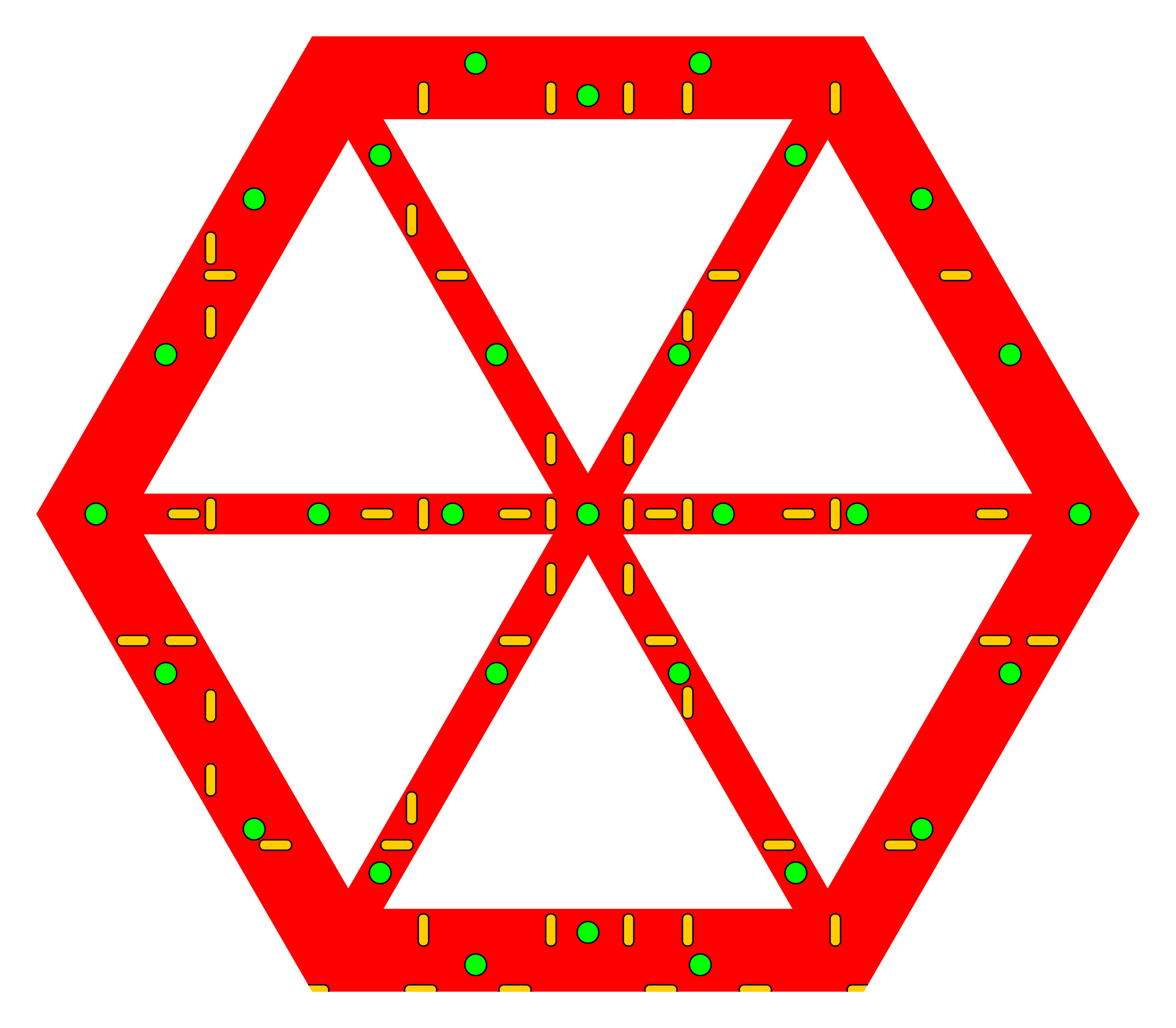
For the wide variety of panel positions on the hexagons, many different attachment points are needed on the exagon: The oval, yellow attachment points in the figure below serve to fix the lower edges of the panels directly to the hexagon. The green circles indicate attachment points for struts, leading to the upper edges of the panels.

Coverage of transport infrastructure of different dimensions

Depending on the orientation of the hexagons (longitudinal or lateral to the road resp. rail) and the number of parallel hexagons, transport infrastructure of various width can be covered (small circles in light blue indicate the position of pillars):

Because of the variety of the span between pillars it seems reasonable to develop at least two variants of the hexagonal carrier elements, a lighter and a more massive, stiffer one.

The proposed dimensions match not only to line-shaped transport infrastructure, but also the wider 16m-grid of big parking lots or a bus station with 7 m wide driveways and 3,5 m wide platforms:

The variant with wider span is also applicable for roundabouts:

Synergies with catenary, fences or noise barriers

The necessity of erecting a lot of pillars along a road or railway line can create synergies with the electrification of transport infrastructure with overhead power lines or the construction of noise barriers. The pillars can also be used for continuous fencing along the line, possibly a decisive factor for facilitating driverless mobility solutions like robotaxis or autonomous buses in rural environments.

Advantages and disadvantages in comparison to free-field photovoltaic and conventionally designed photovoltaic systems for parking lots
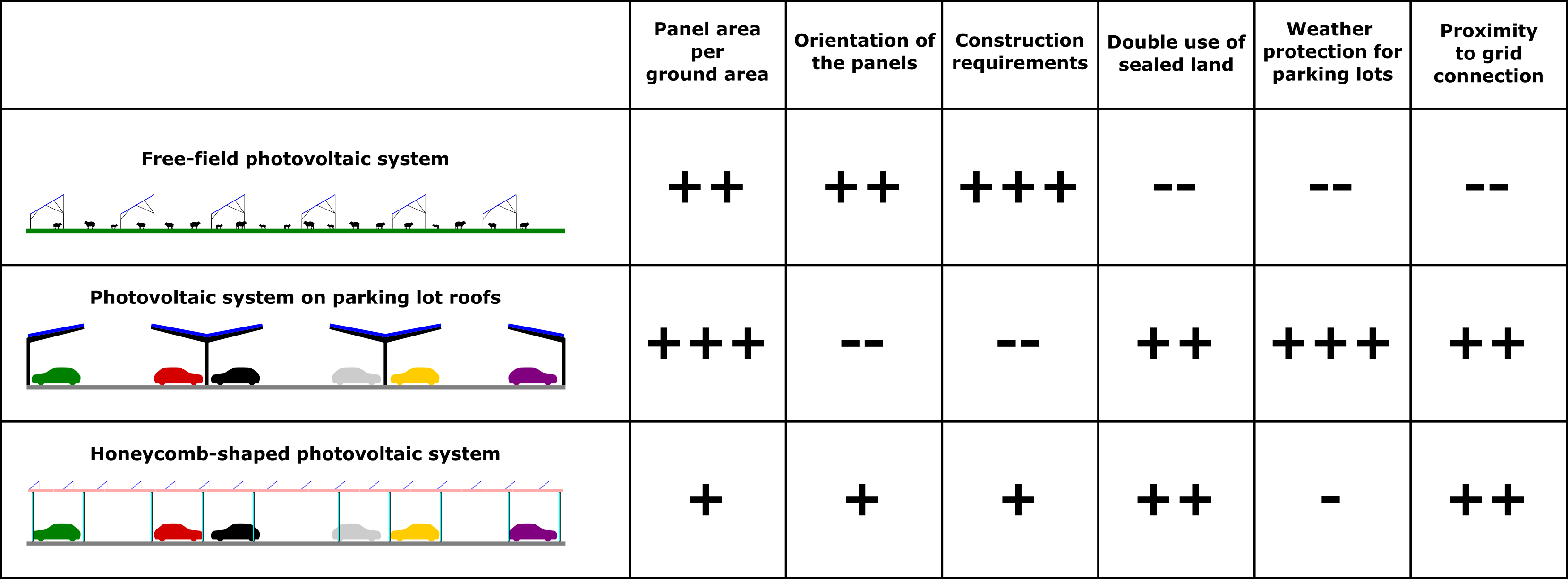
Compared to more conventional photovoltaic systems for parking lots with roofs and panels aligned to the parking pitches, the honeycomb-shaped system achieves much more efficient use of the individual panels, nearly as efficient as a free-field system. This means, that much fewer panels deliver only slighly lower yield. The construction carries significantly less load: a lower number of panels and no snow during winter. Following this criterion, the free-field ist still better too, because of less efforts for height and span width. Advantages of the honeycomb-shaped system are the proximity to grid connection (in particular within city limits or close to them) and double use of already sealed area without any reduction of the use of agricultural area. A disadvantage compared to more conventional solar roofs on parking lots is nearly no rain protection and limited sun protection for the parked vehicles.

Contakt: Harald Buschbacher * * * E-Mail * * * Website