Sharing-optimised Robotaxis: Reconciling Ridesharing with Privacy
Effect on road capacity demand
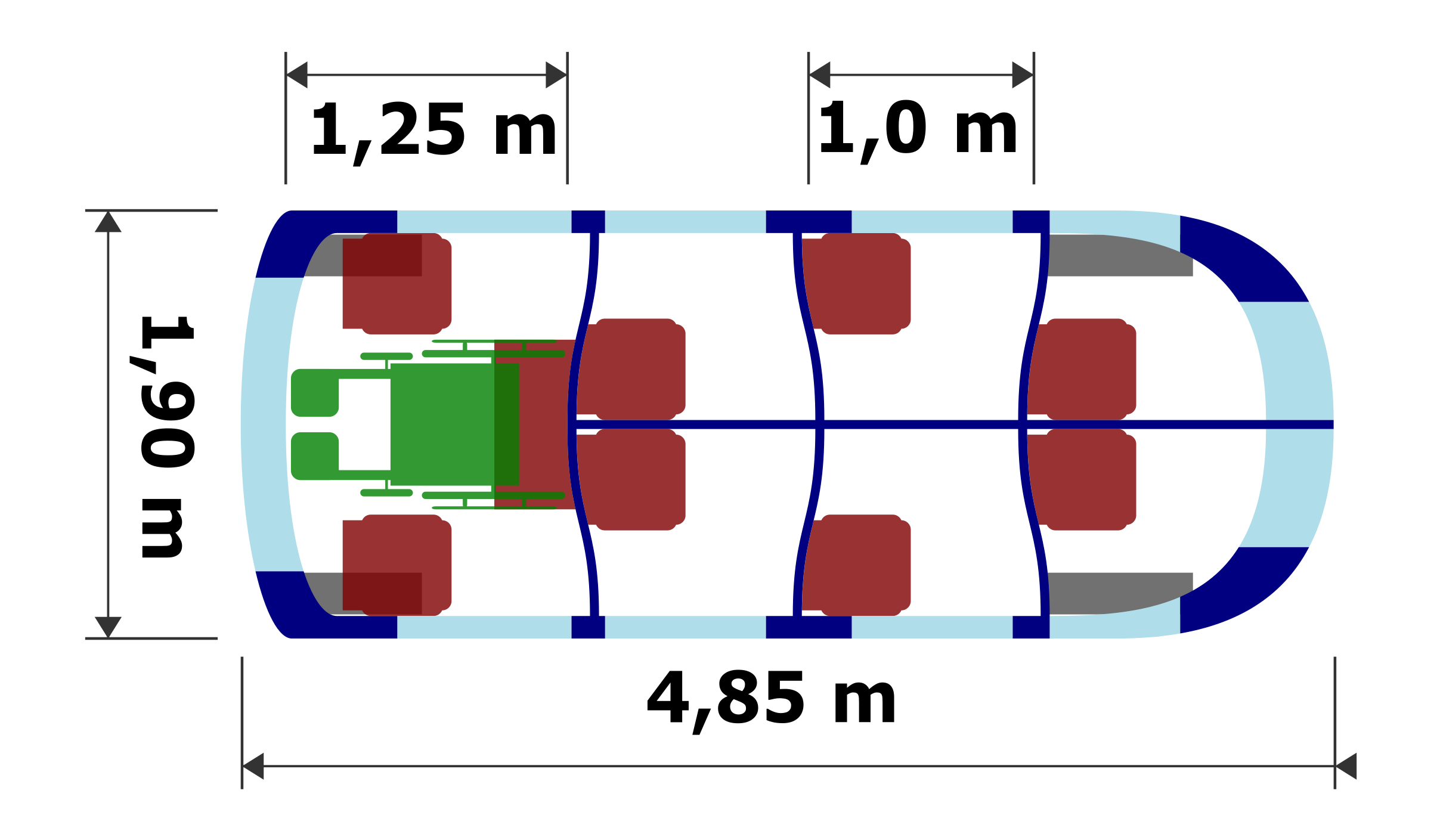
Despite the additional space demand caused by the partitioning, the external size of the 8-seat robotaxi is still in the range of conventional personal cars. Of course, it is slightly longer than an average car and significantly larger than a compact car or even a two-seater light electric vehicle. But as road capacity demand for moving vehicles is dominated by the space between the vehicles, some additional length of the vehicles doesn't significantly increase neither congestion, nor the time pedestrians have to wait before they can cross a street.
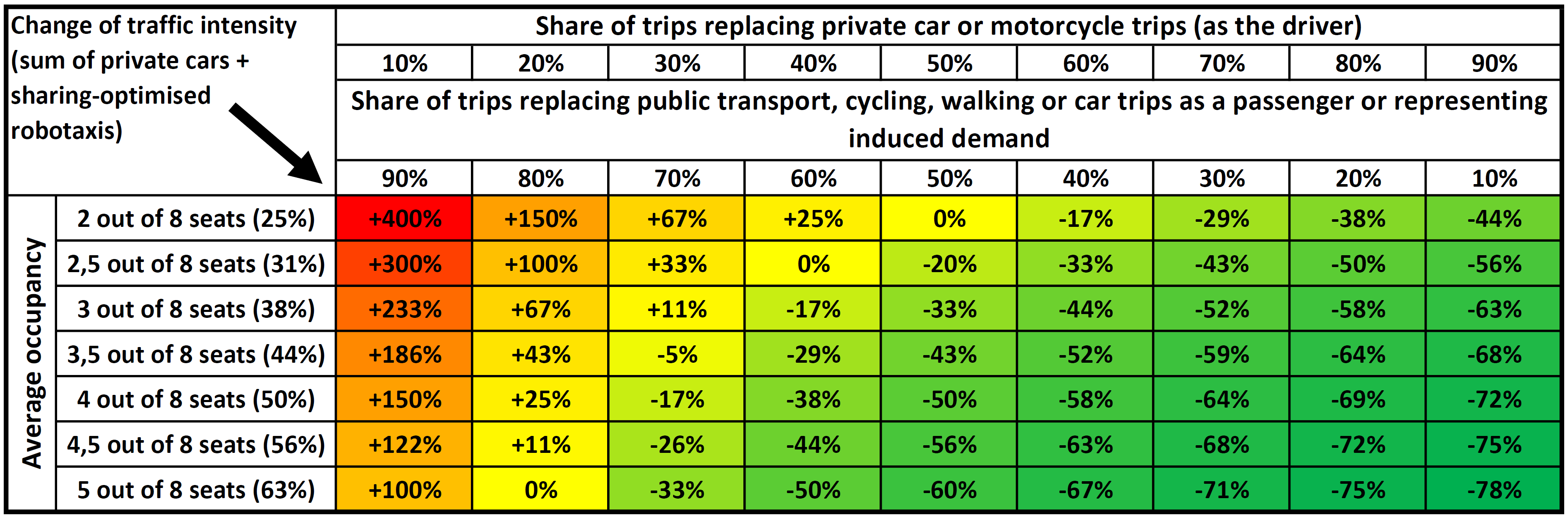 If we neglect both the additional capacity demand caused by the additional length of the sharing-optimised robotaxis on one hand and the capacity demand of cyclists, pedestrians and public transport users on the other hand, the net road capacity effect of the introduction of sharing-optimised robotaxis depends on the average occupancy of the robotaxis and on the share of robotaxi trips replacing trips undertaken by private cars (only counting the drivers, not counting passengers). If the robotaxis achieve an average occupancy of 2.5 passengers per 8-to-10-seat vehicle, it means a reduction of road space usage if at least 40% of the trips replace a trip a person undertakes driving a private car or motorcycle. If on average 5 seats are occupied, the introduction of sharing-optimised robotaxis leads to an improvement of the traffic situation already if 80% of the passengers would otherwise use bike, feet, public transport, a car as a passenger or would not have undertaken the respective trip, and only 20% of the demand is shifted from private car or motorcycle transport.
Regardless of the road capacity demand of driving vehicles, the sharing-optimised robotaxis similar to all other robotaxi, carsharing or public transport solutions reduce the demand for parking space by an order of magnitude as the same vehicle is used for many different trips per day instead of waiting more than 23 hours per day for its owner to use it. In addition, the higher occupancy of sharing-optimised robotaxi, in particular in peak hours, reduces the number of vehicles that are required to move the same number of people. This means not only less space required for parking, but also less resources and emissions for the production of the vehempticles.
Implementation with or without congestion charging
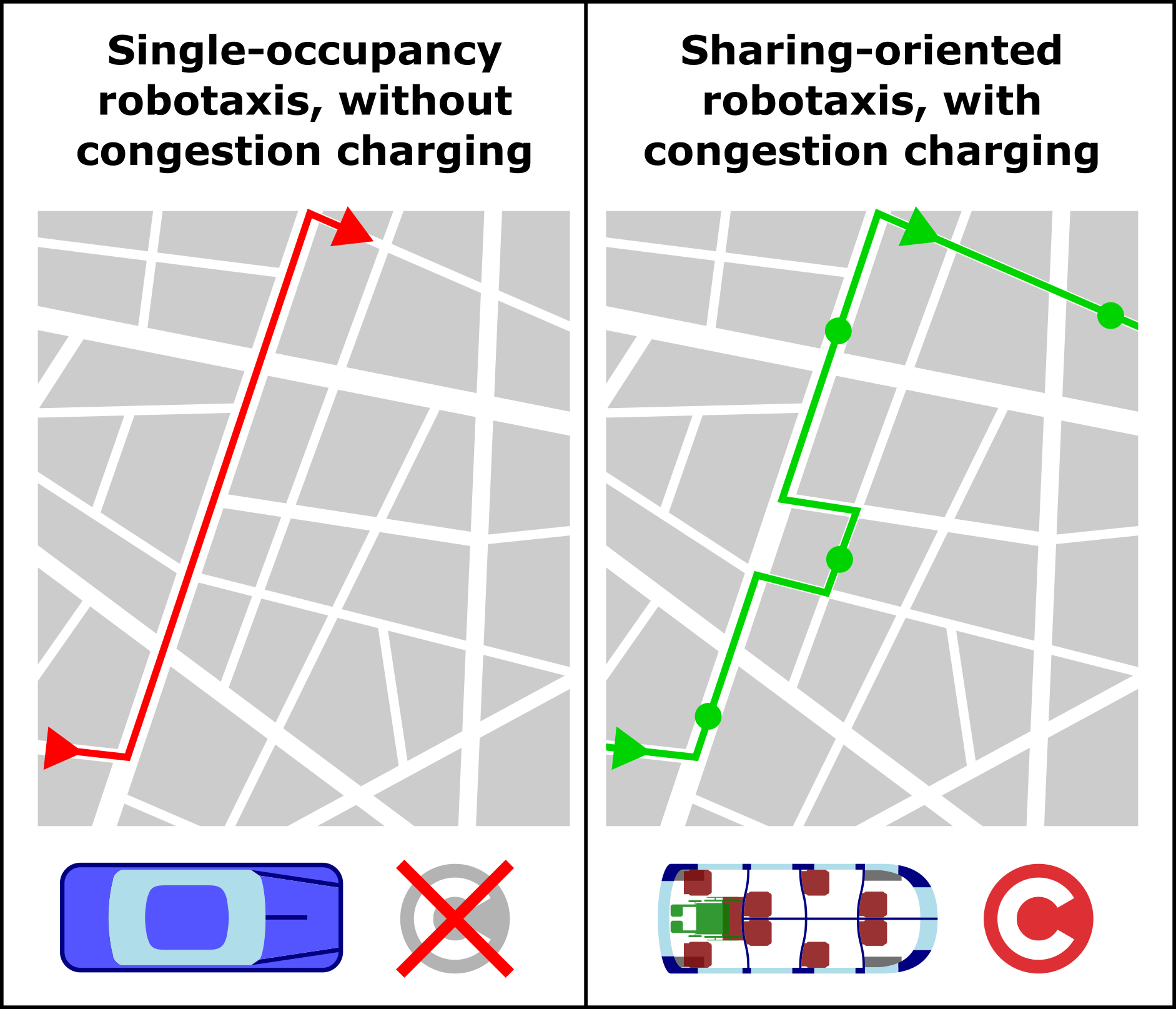
Red: congested roads, low average speed;
Green: no congestion, high average speed
Because of more efficient use of vehicles (including expensive self-driving technology) and energy, there is a high probability, that sharing-optimised robotaxis will be competitive over single-occupancy robotaxis or private cars. If sharing-optimised robotaxis will be implemented, there is also a high probability, that they will contribute to less traffic (green fields in the table above). Nevertheless, cities could significantly improve the competitiveness and the effect of sharing-optimised robotaxis by introducing congestion charges for both robotaxis and conventional cars. If the usage of road capacity costs a fee, in particular at peak hours and in very densely populated areas, it becomes more profitable to maximise the occupancy of the robotaxis (going down in the table above) and there is more incentive to use the robotaxis instead of private cars (going to the right in the table above). In return for the efforts to achieve high occupancy (e.g. detours and intermediate stops), robotaxi operators benefit from shorter travel times facilitated by reduced congestion.
Door-to-door vs access walk
When operating shared robotaxis, door-to-door transportation is not necessarily the best solution in terms of costs and travel time. In particular in urban traffic-calming areas, access to the very entrance of any building often requires significant detours. In these cases, passengers can benefit from shorter travel time if they have a short walk to and from an arterial road before and after the ride. The same applies if two passengers have their origins or their destinations very close to each other, so they can be picked up or dropped off at once, reducing time loss for stopping. In some cases, it might also be beneficial for passengers to interchange between two robotaxis instead of waiting longer for a robotaxi bringing them directly to their destination.
Nevertheless, there should also be an offer for passengers that aren't able or willing to walk to the proposed pick-up point. In dense urban areas with sufficient demand for two or more operators, it would make sense to offer door-to-door services and services with first/last mile walk separately. In more rural areas where separate operation of different services would be inefficient, there could be an extra fee for door-to-door transportation (except for people with reduced mobility).
Conclusions for transport policy
While private companies are interested in introducing robotaxi services starting in city centres, there are concerns by transportation planners and politicians that the introduction of robotaxis in urban areas might lead to more congestion and worse quality of life. The reasons for these concerns are comprehensible: regardless of the higher efficiency in terms of parking space, robotaxis represent more capacity demand on driving lanes because of empty rides and they might trigger a modal shift from public transport to robotaxis. Sharing-optimised robotaxis are the solution for this conflict of interests: They represent a business opportunity for private operators and at the same time a potential for traffic reduction. Instead of inhibiting the development of robotaxi services, it is sufficient if policy makers insist on sharing-optimised solutions and/or create incentives for efficient, shared robotaxi operation like congestion charges or privileges for shared vehicles including sharing-optimised robotaxis.
It is true, that mobility solutions working independently of car ownership and driving license are much more needed in rural and suburban than in urban areas where efficient and popular solutions of public transport, cycling and walking exist. Nevertheless, not all big cities in the world already implemented high-quality public transport and sharing-optimised robotaxis with single-seat compartments are a solution for those who avoid public transport because they do not want to share a room with strangers and aren't open for cycling neither. Furthermore, coverage of suburban and rural areas by robotaxis seems most realistic as an incremental extension from urban areas with high demand density.
Questions and answers
Is it really possible to accommodate six single-seat compartments plus a family/wheelchair-compartment in a vehicle requiring not significantly more road capacity than a conventional car?
As shown in the image above, the length of a single-seat cabin is about one metre. This is more than common seat row spacing in trains, buses or planes. There also exist public transport vehicles with seats faced to a wall with less than one metre from the seat's back end to the wall. Additional space can be gained as the legroom of a rear or middle seat can be partly under the adjacent middle or front seat. Half the width of a standard-sized car (1.9 m) minus space for partitioning and lateral crash buffers is about 70-75 cm - much more than a usual seat width. The space for the wheelchair is derived from elevator standards and in the front and rear areas there are 30 cm (each) added for crash safety requirements.
At a conceptual stage before detailed vehicle design, 5 m length is a realistic assumption. Whether it will be 4.75 or 5.5 m doesn't have a significant impact on road capacity demand, neither whether the cars replaced by the sharing-oriented robotaxis would have an average length of 3.5 or 4 metres. Capacity demand for moving vehicles is dominated by the headway, given by braking distance and safety margins. This concerns both congestion amongst cars but also difficulties for pedestrians to cross roads with intense traffic. This means, that the capacity demand is significantly less than proportional to the vehicle size. Therefore, in transport engineering "passenger car equivalents" are used with a bicycle counted as 0.2-0.5 passenger cars and factors of 1.5-2 for standard trucks and buses and 2-4 for extra long trucks or articulated buses.
(References: https://www.krems.at/fileadmin/Dateien/Downloads/Stadtentwicklung/Oertliches_Entwicklungskonzept/3_MIVTeil1.pdf, https://en.wikipedia.org/wiki/Passenger_car_equivalent & https://de.wikipedia.org/wiki/PKW-Einheit)
How to accommodate luggage in such a vehicle?
For the majority of urban or regional short-to-medium distance trips, there is enough space for luggage within each compartment. For additional luggage, the vehicle could be equipped with storage space above the seats resp. above the compartments or users could just book a second compartment to accommodate their luggage, or the family/wheelchair compartment instead of a single-seat cabin. That's also the reason why for all the calculations, it is regarded to as an 8-seat-vehicle although it is indeed a bit larger (8 standard seats plus space for two children or a wheelchair user).
Wouldn't it be easier and more convenient to just use one vehicle per passenger driving door-to-door without picking up and dropping of other passengers and considering different trips of different passengers in the dispatching of the robotaxis?
From the perspective of a passenger, already sitting in a vehicle it would be easier without intermediate stops for other passengers. With an unlimited number of vehicles, available at any time and place, there would not be a need for sharing neither. But in a real-world scenario where vehicles equipped with all the necessary technology represent the most relevant cost factor, it has to be seen differently: As a passenger, you lose time for intermediate stops, short access walks or even interchanges, but in return, you don't have necessarily to wait until a whole vehicle becomes available, your journey can start when a vehicle with free seats passes in the right direction. From an operator's perspective, there is more effort to coordinate rides, but the required number of vehicles is lower.
If all seats would be occupied at any time, if we count with 8 seats, an average trip with some even distribution of pick-ups and drop-offs would comprise 7 intermediate stops: Between my origin and my destination, seven times one of the other seats is left by one passenger and occupied by another one. In reality, there are two factors leading to a lower number of average intermediate stops: First, some passengers travel in pairs or groups (the reason why average occupancy in conventional car traffic isn't 1, but something between 1,2 and 1,5) and second, passengers with origins or destinations close to each other can be picked up resp. dropped off at the same place. The fact, that a permanent 100% occupancy is not realistic on one hand reduces the number of fellow passengers that must pe picked up and dropped off. On the other hand it can also increase the number of intermediate stops as picking up and dropping off passengers will not always take place at the same location, but there will be one stop where a passenger leaves and after a certain distance another stop where the next passenger takes the same seat.
It is expectable that the average occupancy will be higher in peak hours than in off-peak hours: If more passengers are moving at the same time, it is easier to find more trips that can be bundled together. At the same time, as the fleet demand in peak hours determines the total fleet demand, it is economically much more important to increase occupancy during peak hours than when most of the vehicles are idle anyways.
The balance between advantages and disadvantages is more in favour of sharing-oriented robotaxi solutions when taking into account not only the effects on a single operator or even a single passenger, but all passengers, operators and the city's inhabitants: If all robotaxis are operated in a sharing-optimised way and robotaxis replace many private cars, the level of congestion is reduced and time loss for intermediate stops is compensated by higher average speed between the stops. Therefore, it makes sense for municipalities to introduce congestion charges incentivising the efficient use of road capacity through increased vehicle occupancy.
Is it realistic at all that robotaxis would be operated in a sharing mode with high average occupancy and replace private car traffic? Or does real robotaxi operation rather show opposite tendencies?
It is important to differentiate between pilot projects and a potential widespread application of robotaxis. Current robotaxi services are often too small to make use of purpose-built vehicles and therefore use standard vehicles equipped with the required sensor technology. As they are in a phase of technology development far away from commercial viability, there is no proof, that the current way of operation would represent a market optimum.
From the passenger's point of view, replacing private traffic by robotaxis becomes interesting as soon as robotaxi services (together with public transport) provide sufficient quality and coverage to allow for less car ownership: by selling one's car, not replacing a broken car or living with one instead of two cars in a household. Before this level of robotaxi services is achieved, it is logical that there is a higher share of trips replacing the use of public transport or conventional taxis.
Why exactly this vehicle size?
It is first guess, maybe the optimum would be two seats more or less. But probably it is somewhere in this order of magnitude, because fewer seats would not save much resources and reasonably occupying more seats would require too many intermediate stops. Significantly larger vehicles make sense only in scheduled public transport.
Represent sharing-optimised robotaxis a threat for public transport? Or should we even stop investing in public transport improvements as shared robotaxis might do better than public transport?
At the moment, it is unpredictable which level of costs and quality robotaxis will achieve in the future. There is still a high probability, that either human-steered or autonomous scheduled public transport will remain more efficient and thus competitive over robotaxis (taking also into account public expenses for public transport, as well as the fact that past investments in public transport infrastructure can't be gained back if they aren't used). It is even possible that public transport will gain market share if more people will live without an own car and use regularly public transport and occasionally robotaxis. On the other hand, if it turns out that sharing-optimised robotaxis can fulfil the mobility needs of the population better than scheduled public transport and achieve high ecological resource efficiency too, it would not make sense any more to spend public money for conventional buses, trams or metros. Between these two extreme cases, there are scenarios where public transport eventually remains the better solution during peak hours or on arterial lines, but in some segments, it will be replaced by robotaxis.
Anyways, as long as the technology development remains uncertain, there is no reason to reduce efforts for the improvement of scheduled public transport, both autonomous and human-steered.
By the way, people that are sceptical about robotaxis could call the same solution "autonomous on-demand public minibus transport with privacy-enhanced interior".
Does this mean that the challenge of sustainable and inclusive mobility should be solved by the market, not by public services and transport policy?
The sharing-optimised robotaxi represents an opportunity how to achieve a significant progress in sustainable transportation without much government involvement. This doesn't necessarily mean that it would be better than a government-orchestrated implementation of robotaxi services or a dense network of scheduled autonomous buses running in short intervals. But as most governments are reluctant to actively implement radically improved transportation services based on new technology, it is at least a much better perspective than the choice between either taking the risk of the adverse effects of single-occupancy robotaxis or to impede the development of robotaxi services despite their potential positive effects.
Even if we do not expect a higher level of government involvement, in particular comprehensive public-service contracts, some less intense interventions would be very helpful to make sharing-optimised robotaxi services more efficient and competitive: The introduction of congestion charging and a licensing, franchise or concession scheme at least for rural areas, where the density of population and demand doesn't allow efficient operation of more than one fleet. Further options would be a limitation of the number of operators also in urban areas or a concession scheme combining both more and less profitable areas of operation in order to ensure coverage of the whole territory.
Regardless of the road capacity demand of driving vehicles, the sharing-optimised robotaxis similar to all other robotaxi, carsharing or public transport solutions reduce the demand for parking space by an order of magnitude as the same vehicle is used for many different trips per day instead of waiting more than 23 hours per day for its owner to use it. In addition, the higher occupancy of sharing-optimised robotaxi, in particular in peak hours, reduces the number of vehicles that are required to move the same number of people. This means not only less space required for parking, but also less resources and emissions for the production of the vehempticles.
Implementation with or without congestion charging
Red: congested roads, low average speed;
Green: no congestion, high average speed
Because of more efficient use of vehicles (including expensive self-driving technology) and energy, there is a high probability, that sharing-optimised robotaxis will be competitive over single-occupancy robotaxis or private cars. If sharing-optimised robotaxis will be implemented, there is also a high probability, that they will contribute to less traffic (green fields in the table above). Nevertheless, cities could significantly improve the competitiveness and the effect of sharing-optimised robotaxis by introducing congestion charges for both robotaxis and conventional cars. If the usage of road capacity costs a fee, in particular at peak hours and in very densely populated areas, it becomes more profitable to maximise the occupancy of the robotaxis (going down in the table above) and there is more incentive to use the robotaxis instead of private cars (going to the right in the table above). In return for the efforts to achieve high occupancy (e.g. detours and intermediate stops), robotaxi operators benefit from shorter travel times facilitated by reduced congestion.
Door-to-door vs access walk
When operating shared robotaxis, door-to-door transportation is not necessarily the best solution in terms of costs and travel time. In particular in urban traffic-calming areas, access to the very entrance of any building often requires significant detours. In these cases, passengers can benefit from shorter travel time if they have a short walk to and from an arterial road before and after the ride. The same applies if two passengers have their origins or their destinations very close to each other, so they can be picked up or dropped off at once, reducing time loss for stopping. In some cases, it might also be beneficial for passengers to interchange between two robotaxis instead of waiting longer for a robotaxi bringing them directly to their destination.
Nevertheless, there should also be an offer for passengers that aren't able or willing to walk to the proposed pick-up point. In dense urban areas with sufficient demand for two or more operators, it would make sense to offer door-to-door services and services with first/last mile walk separately. In more rural areas where separate operation of different services would be inefficient, there could be an extra fee for door-to-door transportation (except for people with reduced mobility).
Conclusions for transport policy
While private companies are interested in introducing robotaxi services starting in city centres, there are concerns by transportation planners and politicians that the introduction of robotaxis in urban areas might lead to more congestion and worse quality of life. The reasons for these concerns are comprehensible: regardless of the higher efficiency in terms of parking space, robotaxis represent more capacity demand on driving lanes because of empty rides and they might trigger a modal shift from public transport to robotaxis. Sharing-optimised robotaxis are the solution for this conflict of interests: They represent a business opportunity for private operators and at the same time a potential for traffic reduction. Instead of inhibiting the development of robotaxi services, it is sufficient if policy makers insist on sharing-optimised solutions and/or create incentives for efficient, shared robotaxi operation like congestion charges or privileges for shared vehicles including sharing-optimised robotaxis.
It is true, that mobility solutions working independently of car ownership and driving license are much more needed in rural and suburban than in urban areas where efficient and popular solutions of public transport, cycling and walking exist. Nevertheless, not all big cities in the world already implemented high-quality public transport and sharing-optimised robotaxis with single-seat compartments are a solution for those who avoid public transport because they do not want to share a room with strangers and aren't open for cycling neither. Furthermore, coverage of suburban and rural areas by robotaxis seems most realistic as an incremental extension from urban areas with high demand density.
Questions and answers
Is it really possible to accommodate six single-seat compartments plus a family/wheelchair-compartment in a vehicle requiring not significantly more road capacity than a conventional car?
As shown in the image above, the length of a single-seat cabin is about one metre. This is more than common seat row spacing in trains, buses or planes. There also exist public transport vehicles with seats faced to a wall with less than one metre from the seat's back end to the wall. Additional space can be gained as the legroom of a rear or middle seat can be partly under the adjacent middle or front seat. Half the width of a standard-sized car (1.9 m) minus space for partitioning and lateral crash buffers is about 70-75 cm - much more than a usual seat width. The space for the wheelchair is derived from elevator standards and in the front and rear areas there are 30 cm (each) added for crash safety requirements.
At a conceptual stage before detailed vehicle design, 5 m length is a realistic assumption. Whether it will be 4.75 or 5.5 m doesn't have a significant impact on road capacity demand, neither whether the cars replaced by the sharing-oriented robotaxis would have an average length of 3.5 or 4 metres. Capacity demand for moving vehicles is dominated by the headway, given by braking distance and safety margins. This concerns both congestion amongst cars but also difficulties for pedestrians to cross roads with intense traffic. This means, that the capacity demand is significantly less than proportional to the vehicle size. Therefore, in transport engineering "passenger car equivalents" are used with a bicycle counted as 0.2-0.5 passenger cars and factors of 1.5-2 for standard trucks and buses and 2-4 for extra long trucks or articulated buses.
(References: https://www.krems.at/fileadmin/Dateien/Downloads/Stadtentwicklung/Oertliches_Entwicklungskonzept/3_MIVTeil1.pdf, https://en.wikipedia.org/wiki/Passenger_car_equivalent & https://de.wikipedia.org/wiki/PKW-Einheit)
How to accommodate luggage in such a vehicle?
For the majority of urban or regional short-to-medium distance trips, there is enough space for luggage within each compartment. For additional luggage, the vehicle could be equipped with storage space above the seats resp. above the compartments or users could just book a second compartment to accommodate their luggage, or the family/wheelchair compartment instead of a single-seat cabin. That's also the reason why for all the calculations, it is regarded to as an 8-seat-vehicle although it is indeed a bit larger (8 standard seats plus space for two children or a wheelchair user).
Wouldn't it be easier and more convenient to just use one vehicle per passenger driving door-to-door without picking up and dropping of other passengers and considering different trips of different passengers in the dispatching of the robotaxis?
From the perspective of a passenger, already sitting in a vehicle it would be easier without intermediate stops for other passengers. With an unlimited number of vehicles, available at any time and place, there would not be a need for sharing neither. But in a real-world scenario where vehicles equipped with all the necessary technology represent the most relevant cost factor, it has to be seen differently: As a passenger, you lose time for intermediate stops, short access walks or even interchanges, but in return, you don't have necessarily to wait until a whole vehicle becomes available, your journey can start when a vehicle with free seats passes in the right direction. From an operator's perspective, there is more effort to coordinate rides, but the required number of vehicles is lower.
If all seats would be occupied at any time, if we count with 8 seats, an average trip with some even distribution of pick-ups and drop-offs would comprise 7 intermediate stops: Between my origin and my destination, seven times one of the other seats is left by one passenger and occupied by another one. In reality, there are two factors leading to a lower number of average intermediate stops: First, some passengers travel in pairs or groups (the reason why average occupancy in conventional car traffic isn't 1, but something between 1,2 and 1,5) and second, passengers with origins or destinations close to each other can be picked up resp. dropped off at the same place. The fact, that a permanent 100% occupancy is not realistic on one hand reduces the number of fellow passengers that must pe picked up and dropped off. On the other hand it can also increase the number of intermediate stops as picking up and dropping off passengers will not always take place at the same location, but there will be one stop where a passenger leaves and after a certain distance another stop where the next passenger takes the same seat.
It is expectable that the average occupancy will be higher in peak hours than in off-peak hours: If more passengers are moving at the same time, it is easier to find more trips that can be bundled together. At the same time, as the fleet demand in peak hours determines the total fleet demand, it is economically much more important to increase occupancy during peak hours than when most of the vehicles are idle anyways.
The balance between advantages and disadvantages is more in favour of sharing-oriented robotaxi solutions when taking into account not only the effects on a single operator or even a single passenger, but all passengers, operators and the city's inhabitants: If all robotaxis are operated in a sharing-optimised way and robotaxis replace many private cars, the level of congestion is reduced and time loss for intermediate stops is compensated by higher average speed between the stops. Therefore, it makes sense for municipalities to introduce congestion charges incentivising the efficient use of road capacity through increased vehicle occupancy.
Is it realistic at all that robotaxis would be operated in a sharing mode with high average occupancy and replace private car traffic? Or does real robotaxi operation rather show opposite tendencies?
It is important to differentiate between pilot projects and a potential widespread application of robotaxis. Current robotaxi services are often too small to make use of purpose-built vehicles and therefore use standard vehicles equipped with the required sensor technology. As they are in a phase of technology development far away from commercial viability, there is no proof, that the current way of operation would represent a market optimum.
From the passenger's point of view, replacing private traffic by robotaxis becomes interesting as soon as robotaxi services (together with public transport) provide sufficient quality and coverage to allow for less car ownership: by selling one's car, not replacing a broken car or living with one instead of two cars in a household. Before this level of robotaxi services is achieved, it is logical that there is a higher share of trips replacing the use of public transport or conventional taxis.
Why exactly this vehicle size?
It is first guess, maybe the optimum would be two seats more or less. But probably it is somewhere in this order of magnitude, because fewer seats would not save much resources and reasonably occupying more seats would require too many intermediate stops. Significantly larger vehicles make sense only in scheduled public transport.
Represent sharing-optimised robotaxis a threat for public transport? Or should we even stop investing in public transport improvements as shared robotaxis might do better than public transport?
At the moment, it is unpredictable which level of costs and quality robotaxis will achieve in the future. There is still a high probability, that either human-steered or autonomous scheduled public transport will remain more efficient and thus competitive over robotaxis (taking also into account public expenses for public transport, as well as the fact that past investments in public transport infrastructure can't be gained back if they aren't used). It is even possible that public transport will gain market share if more people will live without an own car and use regularly public transport and occasionally robotaxis. On the other hand, if it turns out that sharing-optimised robotaxis can fulfil the mobility needs of the population better than scheduled public transport and achieve high ecological resource efficiency too, it would not make sense any more to spend public money for conventional buses, trams or metros. Between these two extreme cases, there are scenarios where public transport eventually remains the better solution during peak hours or on arterial lines, but in some segments, it will be replaced by robotaxis.
Anyways, as long as the technology development remains uncertain, there is no reason to reduce efforts for the improvement of scheduled public transport, both autonomous and human-steered.
By the way, people that are sceptical about robotaxis could call the same solution "autonomous on-demand public minibus transport with privacy-enhanced interior".
Does this mean that the challenge of sustainable and inclusive mobility should be solved by the market, not by public services and transport policy?
The sharing-optimised robotaxi represents an opportunity how to achieve a significant progress in sustainable transportation without much government involvement. This doesn't necessarily mean that it would be better than a government-orchestrated implementation of robotaxi services or a dense network of scheduled autonomous buses running in short intervals. But as most governments are reluctant to actively implement radically improved transportation services based on new technology, it is at least a much better perspective than the choice between either taking the risk of the adverse effects of single-occupancy robotaxis or to impede the development of robotaxi services despite their potential positive effects.
Even if we do not expect a higher level of government involvement, in particular comprehensive public-service contracts, some less intense interventions would be very helpful to make sharing-optimised robotaxi services more efficient and competitive: The introduction of congestion charging and a licensing, franchise or concession scheme at least for rural areas, where the density of population and demand doesn't allow efficient operation of more than one fleet. Further options would be a limitation of the number of operators also in urban areas or a concession scheme combining both more and less profitable areas of operation in order to ensure coverage of the whole territory.
Red: congested roads, low average speed;
Green: no congestion, high average speed
Door-to-door vs access walk
When operating shared robotaxis, door-to-door transportation is not necessarily the best solution in terms of costs and travel time. In particular in urban traffic-calming areas, access to the very entrance of any building often requires significant detours. In these cases, passengers can benefit from shorter travel time if they have a short walk to and from an arterial road before and after the ride. The same applies if two passengers have their origins or their destinations very close to each other, so they can be picked up or dropped off at once, reducing time loss for stopping. In some cases, it might also be beneficial for passengers to interchange between two robotaxis instead of waiting longer for a robotaxi bringing them directly to their destination.
Nevertheless, there should also be an offer for passengers that aren't able or willing to walk to the proposed pick-up point. In dense urban areas with sufficient demand for two or more operators, it would make sense to offer door-to-door services and services with first/last mile walk separately. In more rural areas where separate operation of different services would be inefficient, there could be an extra fee for door-to-door transportation (except for people with reduced mobility).
Conclusions for transport policy
While private companies are interested in introducing robotaxi services starting in city centres, there are concerns by transportation planners and politicians that the introduction of robotaxis in urban areas might lead to more congestion and worse quality of life. The reasons for these concerns are comprehensible: regardless of the higher efficiency in terms of parking space, robotaxis represent more capacity demand on driving lanes because of empty rides and they might trigger a modal shift from public transport to robotaxis. Sharing-optimised robotaxis are the solution for this conflict of interests: They represent a business opportunity for private operators and at the same time a potential for traffic reduction. Instead of inhibiting the development of robotaxi services, it is sufficient if policy makers insist on sharing-optimised solutions and/or create incentives for efficient, shared robotaxi operation like congestion charges or privileges for shared vehicles including sharing-optimised robotaxis.
It is true, that mobility solutions working independently of car ownership and driving license are much more needed in rural and suburban than in urban areas where efficient and popular solutions of public transport, cycling and walking exist. Nevertheless, not all big cities in the world already implemented high-quality public transport and sharing-optimised robotaxis with single-seat compartments are a solution for those who avoid public transport because they do not want to share a room with strangers and aren't open for cycling neither. Furthermore, coverage of suburban and rural areas by robotaxis seems most realistic as an incremental extension from urban areas with high demand density.
Questions and answers
Is it really possible to accommodate six single-seat compartments plus a family/wheelchair-compartment in a vehicle requiring not significantly more road capacity than a conventional car?
As shown in the image above, the length of a single-seat cabin is about one metre. This is more than common seat row spacing in trains, buses or planes. There also exist public transport vehicles with seats faced to a wall with less than one metre from the seat's back end to the wall. Additional space can be gained as the legroom of a rear or middle seat can be partly under the adjacent middle or front seat. Half the width of a standard-sized car (1.9 m) minus space for partitioning and lateral crash buffers is about 70-75 cm - much more than a usual seat width. The space for the wheelchair is derived from elevator standards and in the front and rear areas there are 30 cm (each) added for crash safety requirements.
At a conceptual stage before detailed vehicle design, 5 m length is a realistic assumption. Whether it will be 4.75 or 5.5 m doesn't have a significant impact on road capacity demand, neither whether the cars replaced by the sharing-oriented robotaxis would have an average length of 3.5 or 4 metres. Capacity demand for moving vehicles is dominated by the headway, given by braking distance and safety margins. This concerns both congestion amongst cars but also difficulties for pedestrians to cross roads with intense traffic. This means, that the capacity demand is significantly less than proportional to the vehicle size. Therefore, in transport engineering "passenger car equivalents" are used with a bicycle counted as 0.2-0.5 passenger cars and factors of 1.5-2 for standard trucks and buses and 2-4 for extra long trucks or articulated buses.
(References: https://www.krems.at/fileadmin/Dateien/Downloads/Stadtentwicklung/Oertliches_Entwicklungskonzept/3_MIVTeil1.pdf, https://en.wikipedia.org/wiki/Passenger_car_equivalent & https://de.wikipedia.org/wiki/PKW-Einheit)
How to accommodate luggage in such a vehicle?
For the majority of urban or regional short-to-medium distance trips, there is enough space for luggage within each compartment. For additional luggage, the vehicle could be equipped with storage space above the seats resp. above the compartments or users could just book a second compartment to accommodate their luggage, or the family/wheelchair compartment instead of a single-seat cabin. That's also the reason why for all the calculations, it is regarded to as an 8-seat-vehicle although it is indeed a bit larger (8 standard seats plus space for two children or a wheelchair user).
Wouldn't it be easier and more convenient to just use one vehicle per passenger driving door-to-door without picking up and dropping of other passengers and considering different trips of different passengers in the dispatching of the robotaxis?
From the perspective of a passenger, already sitting in a vehicle it would be easier without intermediate stops for other passengers. With an unlimited number of vehicles, available at any time and place, there would not be a need for sharing neither. But in a real-world scenario where vehicles equipped with all the necessary technology represent the most relevant cost factor, it has to be seen differently: As a passenger, you lose time for intermediate stops, short access walks or even interchanges, but in return, you don't have necessarily to wait until a whole vehicle becomes available, your journey can start when a vehicle with free seats passes in the right direction. From an operator's perspective, there is more effort to coordinate rides, but the required number of vehicles is lower.
If all seats would be occupied at any time, if we count with 8 seats, an average trip with some even distribution of pick-ups and drop-offs would comprise 7 intermediate stops: Between my origin and my destination, seven times one of the other seats is left by one passenger and occupied by another one. In reality, there are two factors leading to a lower number of average intermediate stops: First, some passengers travel in pairs or groups (the reason why average occupancy in conventional car traffic isn't 1, but something between 1,2 and 1,5) and second, passengers with origins or destinations close to each other can be picked up resp. dropped off at the same place. The fact, that a permanent 100% occupancy is not realistic on one hand reduces the number of fellow passengers that must pe picked up and dropped off. On the other hand it can also increase the number of intermediate stops as picking up and dropping off passengers will not always take place at the same location, but there will be one stop where a passenger leaves and after a certain distance another stop where the next passenger takes the same seat.
It is expectable that the average occupancy will be higher in peak hours than in off-peak hours: If more passengers are moving at the same time, it is easier to find more trips that can be bundled together. At the same time, as the fleet demand in peak hours determines the total fleet demand, it is economically much more important to increase occupancy during peak hours than when most of the vehicles are idle anyways.
The balance between advantages and disadvantages is more in favour of sharing-oriented robotaxi solutions when taking into account not only the effects on a single operator or even a single passenger, but all passengers, operators and the city's inhabitants: If all robotaxis are operated in a sharing-optimised way and robotaxis replace many private cars, the level of congestion is reduced and time loss for intermediate stops is compensated by higher average speed between the stops. Therefore, it makes sense for municipalities to introduce congestion charges incentivising the efficient use of road capacity through increased vehicle occupancy.
Is it realistic at all that robotaxis would be operated in a sharing mode with high average occupancy and replace private car traffic? Or does real robotaxi operation rather show opposite tendencies?
It is important to differentiate between pilot projects and a potential widespread application of robotaxis. Current robotaxi services are often too small to make use of purpose-built vehicles and therefore use standard vehicles equipped with the required sensor technology. As they are in a phase of technology development far away from commercial viability, there is no proof, that the current way of operation would represent a market optimum.
From the passenger's point of view, replacing private traffic by robotaxis becomes interesting as soon as robotaxi services (together with public transport) provide sufficient quality and coverage to allow for less car ownership: by selling one's car, not replacing a broken car or living with one instead of two cars in a household. Before this level of robotaxi services is achieved, it is logical that there is a higher share of trips replacing the use of public transport or conventional taxis.
Why exactly this vehicle size?
It is first guess, maybe the optimum would be two seats more or less. But probably it is somewhere in this order of magnitude, because fewer seats would not save much resources and reasonably occupying more seats would require too many intermediate stops. Significantly larger vehicles make sense only in scheduled public transport.
Represent sharing-optimised robotaxis a threat for public transport? Or should we even stop investing in public transport improvements as shared robotaxis might do better than public transport?
At the moment, it is unpredictable which level of costs and quality robotaxis will achieve in the future. There is still a high probability, that either human-steered or autonomous scheduled public transport will remain more efficient and thus competitive over robotaxis (taking also into account public expenses for public transport, as well as the fact that past investments in public transport infrastructure can't be gained back if they aren't used). It is even possible that public transport will gain market share if more people will live without an own car and use regularly public transport and occasionally robotaxis. On the other hand, if it turns out that sharing-optimised robotaxis can fulfil the mobility needs of the population better than scheduled public transport and achieve high ecological resource efficiency too, it would not make sense any more to spend public money for conventional buses, trams or metros. Between these two extreme cases, there are scenarios where public transport eventually remains the better solution during peak hours or on arterial lines, but in some segments, it will be replaced by robotaxis.
Anyways, as long as the technology development remains uncertain, there is no reason to reduce efforts for the improvement of scheduled public transport, both autonomous and human-steered.
By the way, people that are sceptical about robotaxis could call the same solution "autonomous on-demand public minibus transport with privacy-enhanced interior".
Does this mean that the challenge of sustainable and inclusive mobility should be solved by the market, not by public services and transport policy?
The sharing-optimised robotaxi represents an opportunity how to achieve a significant progress in sustainable transportation without much government involvement. This doesn't necessarily mean that it would be better than a government-orchestrated implementation of robotaxi services or a dense network of scheduled autonomous buses running in short intervals. But as most governments are reluctant to actively implement radically improved transportation services based on new technology, it is at least a much better perspective than the choice between either taking the risk of the adverse effects of single-occupancy robotaxis or to impede the development of robotaxi services despite their potential positive effects.
Even if we do not expect a higher level of government involvement, in particular comprehensive public-service contracts, some less intense interventions would be very helpful to make sharing-optimised robotaxi services more efficient and competitive: The introduction of congestion charging and a licensing, franchise or concession scheme at least for rural areas, where the density of population and demand doesn't allow efficient operation of more than one fleet. Further options would be a limitation of the number of operators also in urban areas or a concession scheme combining both more and less profitable areas of operation in order to ensure coverage of the whole territory.
Nevertheless, there should also be an offer for passengers that aren't able or willing to walk to the proposed pick-up point. In dense urban areas with sufficient demand for two or more operators, it would make sense to offer door-to-door services and services with first/last mile walk separately. In more rural areas where separate operation of different services would be inefficient, there could be an extra fee for door-to-door transportation (except for people with reduced mobility).
Conclusions for transport policy
While private companies are interested in introducing robotaxi services starting in city centres, there are concerns by transportation planners and politicians that the introduction of robotaxis in urban areas might lead to more congestion and worse quality of life. The reasons for these concerns are comprehensible: regardless of the higher efficiency in terms of parking space, robotaxis represent more capacity demand on driving lanes because of empty rides and they might trigger a modal shift from public transport to robotaxis. Sharing-optimised robotaxis are the solution for this conflict of interests: They represent a business opportunity for private operators and at the same time a potential for traffic reduction. Instead of inhibiting the development of robotaxi services, it is sufficient if policy makers insist on sharing-optimised solutions and/or create incentives for efficient, shared robotaxi operation like congestion charges or privileges for shared vehicles including sharing-optimised robotaxis.
It is true, that mobility solutions working independently of car ownership and driving license are much more needed in rural and suburban than in urban areas where efficient and popular solutions of public transport, cycling and walking exist. Nevertheless, not all big cities in the world already implemented high-quality public transport and sharing-optimised robotaxis with single-seat compartments are a solution for those who avoid public transport because they do not want to share a room with strangers and aren't open for cycling neither. Furthermore, coverage of suburban and rural areas by robotaxis seems most realistic as an incremental extension from urban areas with high demand density.
Questions and answers
Is it really possible to accommodate six single-seat compartments plus a family/wheelchair-compartment in a vehicle requiring not significantly more road capacity than a conventional car?
As shown in the image above, the length of a single-seat cabin is about one metre. This is more than common seat row spacing in trains, buses or planes. There also exist public transport vehicles with seats faced to a wall with less than one metre from the seat's back end to the wall. Additional space can be gained as the legroom of a rear or middle seat can be partly under the adjacent middle or front seat. Half the width of a standard-sized car (1.9 m) minus space for partitioning and lateral crash buffers is about 70-75 cm - much more than a usual seat width. The space for the wheelchair is derived from elevator standards and in the front and rear areas there are 30 cm (each) added for crash safety requirements.
At a conceptual stage before detailed vehicle design, 5 m length is a realistic assumption. Whether it will be 4.75 or 5.5 m doesn't have a significant impact on road capacity demand, neither whether the cars replaced by the sharing-oriented robotaxis would have an average length of 3.5 or 4 metres. Capacity demand for moving vehicles is dominated by the headway, given by braking distance and safety margins. This concerns both congestion amongst cars but also difficulties for pedestrians to cross roads with intense traffic. This means, that the capacity demand is significantly less than proportional to the vehicle size. Therefore, in transport engineering "passenger car equivalents" are used with a bicycle counted as 0.2-0.5 passenger cars and factors of 1.5-2 for standard trucks and buses and 2-4 for extra long trucks or articulated buses.
(References: https://www.krems.at/fileadmin/Dateien/Downloads/Stadtentwicklung/Oertliches_Entwicklungskonzept/3_MIVTeil1.pdf, https://en.wikipedia.org/wiki/Passenger_car_equivalent & https://de.wikipedia.org/wiki/PKW-Einheit)
How to accommodate luggage in such a vehicle?
For the majority of urban or regional short-to-medium distance trips, there is enough space for luggage within each compartment. For additional luggage, the vehicle could be equipped with storage space above the seats resp. above the compartments or users could just book a second compartment to accommodate their luggage, or the family/wheelchair compartment instead of a single-seat cabin. That's also the reason why for all the calculations, it is regarded to as an 8-seat-vehicle although it is indeed a bit larger (8 standard seats plus space for two children or a wheelchair user).
Wouldn't it be easier and more convenient to just use one vehicle per passenger driving door-to-door without picking up and dropping of other passengers and considering different trips of different passengers in the dispatching of the robotaxis?
From the perspective of a passenger, already sitting in a vehicle it would be easier without intermediate stops for other passengers. With an unlimited number of vehicles, available at any time and place, there would not be a need for sharing neither. But in a real-world scenario where vehicles equipped with all the necessary technology represent the most relevant cost factor, it has to be seen differently: As a passenger, you lose time for intermediate stops, short access walks or even interchanges, but in return, you don't have necessarily to wait until a whole vehicle becomes available, your journey can start when a vehicle with free seats passes in the right direction. From an operator's perspective, there is more effort to coordinate rides, but the required number of vehicles is lower.
If all seats would be occupied at any time, if we count with 8 seats, an average trip with some even distribution of pick-ups and drop-offs would comprise 7 intermediate stops: Between my origin and my destination, seven times one of the other seats is left by one passenger and occupied by another one. In reality, there are two factors leading to a lower number of average intermediate stops: First, some passengers travel in pairs or groups (the reason why average occupancy in conventional car traffic isn't 1, but something between 1,2 and 1,5) and second, passengers with origins or destinations close to each other can be picked up resp. dropped off at the same place. The fact, that a permanent 100% occupancy is not realistic on one hand reduces the number of fellow passengers that must pe picked up and dropped off. On the other hand it can also increase the number of intermediate stops as picking up and dropping off passengers will not always take place at the same location, but there will be one stop where a passenger leaves and after a certain distance another stop where the next passenger takes the same seat.
It is expectable that the average occupancy will be higher in peak hours than in off-peak hours: If more passengers are moving at the same time, it is easier to find more trips that can be bundled together. At the same time, as the fleet demand in peak hours determines the total fleet demand, it is economically much more important to increase occupancy during peak hours than when most of the vehicles are idle anyways.
The balance between advantages and disadvantages is more in favour of sharing-oriented robotaxi solutions when taking into account not only the effects on a single operator or even a single passenger, but all passengers, operators and the city's inhabitants: If all robotaxis are operated in a sharing-optimised way and robotaxis replace many private cars, the level of congestion is reduced and time loss for intermediate stops is compensated by higher average speed between the stops. Therefore, it makes sense for municipalities to introduce congestion charges incentivising the efficient use of road capacity through increased vehicle occupancy.
Is it realistic at all that robotaxis would be operated in a sharing mode with high average occupancy and replace private car traffic? Or does real robotaxi operation rather show opposite tendencies?
It is important to differentiate between pilot projects and a potential widespread application of robotaxis. Current robotaxi services are often too small to make use of purpose-built vehicles and therefore use standard vehicles equipped with the required sensor technology. As they are in a phase of technology development far away from commercial viability, there is no proof, that the current way of operation would represent a market optimum.
From the passenger's point of view, replacing private traffic by robotaxis becomes interesting as soon as robotaxi services (together with public transport) provide sufficient quality and coverage to allow for less car ownership: by selling one's car, not replacing a broken car or living with one instead of two cars in a household. Before this level of robotaxi services is achieved, it is logical that there is a higher share of trips replacing the use of public transport or conventional taxis.
Why exactly this vehicle size?
It is first guess, maybe the optimum would be two seats more or less. But probably it is somewhere in this order of magnitude, because fewer seats would not save much resources and reasonably occupying more seats would require too many intermediate stops. Significantly larger vehicles make sense only in scheduled public transport.
Represent sharing-optimised robotaxis a threat for public transport? Or should we even stop investing in public transport improvements as shared robotaxis might do better than public transport?
At the moment, it is unpredictable which level of costs and quality robotaxis will achieve in the future. There is still a high probability, that either human-steered or autonomous scheduled public transport will remain more efficient and thus competitive over robotaxis (taking also into account public expenses for public transport, as well as the fact that past investments in public transport infrastructure can't be gained back if they aren't used). It is even possible that public transport will gain market share if more people will live without an own car and use regularly public transport and occasionally robotaxis. On the other hand, if it turns out that sharing-optimised robotaxis can fulfil the mobility needs of the population better than scheduled public transport and achieve high ecological resource efficiency too, it would not make sense any more to spend public money for conventional buses, trams or metros. Between these two extreme cases, there are scenarios where public transport eventually remains the better solution during peak hours or on arterial lines, but in some segments, it will be replaced by robotaxis.
Anyways, as long as the technology development remains uncertain, there is no reason to reduce efforts for the improvement of scheduled public transport, both autonomous and human-steered.
By the way, people that are sceptical about robotaxis could call the same solution "autonomous on-demand public minibus transport with privacy-enhanced interior".
Does this mean that the challenge of sustainable and inclusive mobility should be solved by the market, not by public services and transport policy?
The sharing-optimised robotaxi represents an opportunity how to achieve a significant progress in sustainable transportation without much government involvement. This doesn't necessarily mean that it would be better than a government-orchestrated implementation of robotaxi services or a dense network of scheduled autonomous buses running in short intervals. But as most governments are reluctant to actively implement radically improved transportation services based on new technology, it is at least a much better perspective than the choice between either taking the risk of the adverse effects of single-occupancy robotaxis or to impede the development of robotaxi services despite their potential positive effects.
Even if we do not expect a higher level of government involvement, in particular comprehensive public-service contracts, some less intense interventions would be very helpful to make sharing-optimised robotaxi services more efficient and competitive: The introduction of congestion charging and a licensing, franchise or concession scheme at least for rural areas, where the density of population and demand doesn't allow efficient operation of more than one fleet. Further options would be a limitation of the number of operators also in urban areas or a concession scheme combining both more and less profitable areas of operation in order to ensure coverage of the whole territory.
It is true, that mobility solutions working independently of car ownership and driving license are much more needed in rural and suburban than in urban areas where efficient and popular solutions of public transport, cycling and walking exist. Nevertheless, not all big cities in the world already implemented high-quality public transport and sharing-optimised robotaxis with single-seat compartments are a solution for those who avoid public transport because they do not want to share a room with strangers and aren't open for cycling neither. Furthermore, coverage of suburban and rural areas by robotaxis seems most realistic as an incremental extension from urban areas with high demand density.
Questions and answers
Is it really possible to accommodate six single-seat compartments plus a family/wheelchair-compartment in a vehicle requiring not significantly more road capacity than a conventional car?
As shown in the image above, the length of a single-seat cabin is about one metre. This is more than common seat row spacing in trains, buses or planes. There also exist public transport vehicles with seats faced to a wall with less than one metre from the seat's back end to the wall. Additional space can be gained as the legroom of a rear or middle seat can be partly under the adjacent middle or front seat. Half the width of a standard-sized car (1.9 m) minus space for partitioning and lateral crash buffers is about 70-75 cm - much more than a usual seat width. The space for the wheelchair is derived from elevator standards and in the front and rear areas there are 30 cm (each) added for crash safety requirements.
At a conceptual stage before detailed vehicle design, 5 m length is a realistic assumption. Whether it will be 4.75 or 5.5 m doesn't have a significant impact on road capacity demand, neither whether the cars replaced by the sharing-oriented robotaxis would have an average length of 3.5 or 4 metres. Capacity demand for moving vehicles is dominated by the headway, given by braking distance and safety margins. This concerns both congestion amongst cars but also difficulties for pedestrians to cross roads with intense traffic. This means, that the capacity demand is significantly less than proportional to the vehicle size. Therefore, in transport engineering "passenger car equivalents" are used with a bicycle counted as 0.2-0.5 passenger cars and factors of 1.5-2 for standard trucks and buses and 2-4 for extra long trucks or articulated buses.
(References: https://www.krems.at/fileadmin/Dateien/Downloads/Stadtentwicklung/Oertliches_Entwicklungskonzept/3_MIVTeil1.pdf, https://en.wikipedia.org/wiki/Passenger_car_equivalent & https://de.wikipedia.org/wiki/PKW-Einheit)
How to accommodate luggage in such a vehicle?
For the majority of urban or regional short-to-medium distance trips, there is enough space for luggage within each compartment. For additional luggage, the vehicle could be equipped with storage space above the seats resp. above the compartments or users could just book a second compartment to accommodate their luggage, or the family/wheelchair compartment instead of a single-seat cabin. That's also the reason why for all the calculations, it is regarded to as an 8-seat-vehicle although it is indeed a bit larger (8 standard seats plus space for two children or a wheelchair user).
Wouldn't it be easier and more convenient to just use one vehicle per passenger driving door-to-door without picking up and dropping of other passengers and considering different trips of different passengers in the dispatching of the robotaxis?
From the perspective of a passenger, already sitting in a vehicle it would be easier without intermediate stops for other passengers. With an unlimited number of vehicles, available at any time and place, there would not be a need for sharing neither. But in a real-world scenario where vehicles equipped with all the necessary technology represent the most relevant cost factor, it has to be seen differently: As a passenger, you lose time for intermediate stops, short access walks or even interchanges, but in return, you don't have necessarily to wait until a whole vehicle becomes available, your journey can start when a vehicle with free seats passes in the right direction. From an operator's perspective, there is more effort to coordinate rides, but the required number of vehicles is lower.
If all seats would be occupied at any time, if we count with 8 seats, an average trip with some even distribution of pick-ups and drop-offs would comprise 7 intermediate stops: Between my origin and my destination, seven times one of the other seats is left by one passenger and occupied by another one. In reality, there are two factors leading to a lower number of average intermediate stops: First, some passengers travel in pairs or groups (the reason why average occupancy in conventional car traffic isn't 1, but something between 1,2 and 1,5) and second, passengers with origins or destinations close to each other can be picked up resp. dropped off at the same place. The fact, that a permanent 100% occupancy is not realistic on one hand reduces the number of fellow passengers that must pe picked up and dropped off. On the other hand it can also increase the number of intermediate stops as picking up and dropping off passengers will not always take place at the same location, but there will be one stop where a passenger leaves and after a certain distance another stop where the next passenger takes the same seat.
It is expectable that the average occupancy will be higher in peak hours than in off-peak hours: If more passengers are moving at the same time, it is easier to find more trips that can be bundled together. At the same time, as the fleet demand in peak hours determines the total fleet demand, it is economically much more important to increase occupancy during peak hours than when most of the vehicles are idle anyways.
The balance between advantages and disadvantages is more in favour of sharing-oriented robotaxi solutions when taking into account not only the effects on a single operator or even a single passenger, but all passengers, operators and the city's inhabitants: If all robotaxis are operated in a sharing-optimised way and robotaxis replace many private cars, the level of congestion is reduced and time loss for intermediate stops is compensated by higher average speed between the stops. Therefore, it makes sense for municipalities to introduce congestion charges incentivising the efficient use of road capacity through increased vehicle occupancy.
Is it realistic at all that robotaxis would be operated in a sharing mode with high average occupancy and replace private car traffic? Or does real robotaxi operation rather show opposite tendencies?
It is important to differentiate between pilot projects and a potential widespread application of robotaxis. Current robotaxi services are often too small to make use of purpose-built vehicles and therefore use standard vehicles equipped with the required sensor technology. As they are in a phase of technology development far away from commercial viability, there is no proof, that the current way of operation would represent a market optimum.
From the passenger's point of view, replacing private traffic by robotaxis becomes interesting as soon as robotaxi services (together with public transport) provide sufficient quality and coverage to allow for less car ownership: by selling one's car, not replacing a broken car or living with one instead of two cars in a household. Before this level of robotaxi services is achieved, it is logical that there is a higher share of trips replacing the use of public transport or conventional taxis.
Why exactly this vehicle size?
It is first guess, maybe the optimum would be two seats more or less. But probably it is somewhere in this order of magnitude, because fewer seats would not save much resources and reasonably occupying more seats would require too many intermediate stops. Significantly larger vehicles make sense only in scheduled public transport.
Represent sharing-optimised robotaxis a threat for public transport? Or should we even stop investing in public transport improvements as shared robotaxis might do better than public transport?
At the moment, it is unpredictable which level of costs and quality robotaxis will achieve in the future. There is still a high probability, that either human-steered or autonomous scheduled public transport will remain more efficient and thus competitive over robotaxis (taking also into account public expenses for public transport, as well as the fact that past investments in public transport infrastructure can't be gained back if they aren't used). It is even possible that public transport will gain market share if more people will live without an own car and use regularly public transport and occasionally robotaxis. On the other hand, if it turns out that sharing-optimised robotaxis can fulfil the mobility needs of the population better than scheduled public transport and achieve high ecological resource efficiency too, it would not make sense any more to spend public money for conventional buses, trams or metros. Between these two extreme cases, there are scenarios where public transport eventually remains the better solution during peak hours or on arterial lines, but in some segments, it will be replaced by robotaxis.
Anyways, as long as the technology development remains uncertain, there is no reason to reduce efforts for the improvement of scheduled public transport, both autonomous and human-steered.
By the way, people that are sceptical about robotaxis could call the same solution "autonomous on-demand public minibus transport with privacy-enhanced interior".
Does this mean that the challenge of sustainable and inclusive mobility should be solved by the market, not by public services and transport policy?
The sharing-optimised robotaxi represents an opportunity how to achieve a significant progress in sustainable transportation without much government involvement. This doesn't necessarily mean that it would be better than a government-orchestrated implementation of robotaxi services or a dense network of scheduled autonomous buses running in short intervals. But as most governments are reluctant to actively implement radically improved transportation services based on new technology, it is at least a much better perspective than the choice between either taking the risk of the adverse effects of single-occupancy robotaxis or to impede the development of robotaxi services despite their potential positive effects.
Even if we do not expect a higher level of government involvement, in particular comprehensive public-service contracts, some less intense interventions would be very helpful to make sharing-optimised robotaxi services more efficient and competitive: The introduction of congestion charging and a licensing, franchise or concession scheme at least for rural areas, where the density of population and demand doesn't allow efficient operation of more than one fleet. Further options would be a limitation of the number of operators also in urban areas or a concession scheme combining both more and less profitable areas of operation in order to ensure coverage of the whole territory.
Is it really possible to accommodate six single-seat compartments plus a family/wheelchair-compartment in a vehicle requiring not significantly more road capacity than a conventional car? How to accommodate luggage in such a vehicle? Wouldn't it be easier and more convenient to just use one vehicle per passenger driving door-to-door without picking up and dropping of other passengers and considering different trips of different passengers in the dispatching of the robotaxis? Is it realistic at all that robotaxis would be operated in a sharing mode with high average occupancy and replace private car traffic? Or does real robotaxi operation rather show opposite tendencies? Why exactly this vehicle size? Represent sharing-optimised robotaxis a threat for public transport? Or should we even stop investing in public transport improvements as shared robotaxis might do better than public transport? Does this mean that the challenge of sustainable and inclusive mobility should be solved by the market, not by public services and transport policy?
As shown in the image above, the length of a single-seat cabin is about one metre. This is more than common seat row spacing in trains, buses or planes. There also exist public transport vehicles with seats faced to a wall with less than one metre from the seat's back end to the wall. Additional space can be gained as the legroom of a rear or middle seat can be partly under the adjacent middle or front seat. Half the width of a standard-sized car (1.9 m) minus space for partitioning and lateral crash buffers is about 70-75 cm - much more than a usual seat width. The space for the wheelchair is derived from elevator standards and in the front and rear areas there are 30 cm (each) added for crash safety requirements.
At a conceptual stage before detailed vehicle design, 5 m length is a realistic assumption. Whether it will be 4.75 or 5.5 m doesn't have a significant impact on road capacity demand, neither whether the cars replaced by the sharing-oriented robotaxis would have an average length of 3.5 or 4 metres. Capacity demand for moving vehicles is dominated by the headway, given by braking distance and safety margins. This concerns both congestion amongst cars but also difficulties for pedestrians to cross roads with intense traffic. This means, that the capacity demand is significantly less than proportional to the vehicle size. Therefore, in transport engineering "passenger car equivalents" are used with a bicycle counted as 0.2-0.5 passenger cars and factors of 1.5-2 for standard trucks and buses and 2-4 for extra long trucks or articulated buses.
(References: https://www.krems.at/fileadmin/Dateien/Downloads/Stadtentwicklung/Oertliches_Entwicklungskonzept/3_MIVTeil1.pdf, https://en.wikipedia.org/wiki/Passenger_car_equivalent & https://de.wikipedia.org/wiki/PKW-Einheit)
For the majority of urban or regional short-to-medium distance trips, there is enough space for luggage within each compartment. For additional luggage, the vehicle could be equipped with storage space above the seats resp. above the compartments or users could just book a second compartment to accommodate their luggage, or the family/wheelchair compartment instead of a single-seat cabin. That's also the reason why for all the calculations, it is regarded to as an 8-seat-vehicle although it is indeed a bit larger (8 standard seats plus space for two children or a wheelchair user).
From the perspective of a passenger, already sitting in a vehicle it would be easier without intermediate stops for other passengers. With an unlimited number of vehicles, available at any time and place, there would not be a need for sharing neither. But in a real-world scenario where vehicles equipped with all the necessary technology represent the most relevant cost factor, it has to be seen differently: As a passenger, you lose time for intermediate stops, short access walks or even interchanges, but in return, you don't have necessarily to wait until a whole vehicle becomes available, your journey can start when a vehicle with free seats passes in the right direction. From an operator's perspective, there is more effort to coordinate rides, but the required number of vehicles is lower.
If all seats would be occupied at any time, if we count with 8 seats, an average trip with some even distribution of pick-ups and drop-offs would comprise 7 intermediate stops: Between my origin and my destination, seven times one of the other seats is left by one passenger and occupied by another one. In reality, there are two factors leading to a lower number of average intermediate stops: First, some passengers travel in pairs or groups (the reason why average occupancy in conventional car traffic isn't 1, but something between 1,2 and 1,5) and second, passengers with origins or destinations close to each other can be picked up resp. dropped off at the same place. The fact, that a permanent 100% occupancy is not realistic on one hand reduces the number of fellow passengers that must pe picked up and dropped off. On the other hand it can also increase the number of intermediate stops as picking up and dropping off passengers will not always take place at the same location, but there will be one stop where a passenger leaves and after a certain distance another stop where the next passenger takes the same seat.
It is expectable that the average occupancy will be higher in peak hours than in off-peak hours: If more passengers are moving at the same time, it is easier to find more trips that can be bundled together. At the same time, as the fleet demand in peak hours determines the total fleet demand, it is economically much more important to increase occupancy during peak hours than when most of the vehicles are idle anyways.
The balance between advantages and disadvantages is more in favour of sharing-oriented robotaxi solutions when taking into account not only the effects on a single operator or even a single passenger, but all passengers, operators and the city's inhabitants: If all robotaxis are operated in a sharing-optimised way and robotaxis replace many private cars, the level of congestion is reduced and time loss for intermediate stops is compensated by higher average speed between the stops. Therefore, it makes sense for municipalities to introduce congestion charges incentivising the efficient use of road capacity through increased vehicle occupancy.
It is important to differentiate between pilot projects and a potential widespread application of robotaxis. Current robotaxi services are often too small to make use of purpose-built vehicles and therefore use standard vehicles equipped with the required sensor technology. As they are in a phase of technology development far away from commercial viability, there is no proof, that the current way of operation would represent a market optimum.
From the passenger's point of view, replacing private traffic by robotaxis becomes interesting as soon as robotaxi services (together with public transport) provide sufficient quality and coverage to allow for less car ownership: by selling one's car, not replacing a broken car or living with one instead of two cars in a household. Before this level of robotaxi services is achieved, it is logical that there is a higher share of trips replacing the use of public transport or conventional taxis.
It is first guess, maybe the optimum would be two seats more or less. But probably it is somewhere in this order of magnitude, because fewer seats would not save much resources and reasonably occupying more seats would require too many intermediate stops. Significantly larger vehicles make sense only in scheduled public transport.
At the moment, it is unpredictable which level of costs and quality robotaxis will achieve in the future. There is still a high probability, that either human-steered or autonomous scheduled public transport will remain more efficient and thus competitive over robotaxis (taking also into account public expenses for public transport, as well as the fact that past investments in public transport infrastructure can't be gained back if they aren't used). It is even possible that public transport will gain market share if more people will live without an own car and use regularly public transport and occasionally robotaxis. On the other hand, if it turns out that sharing-optimised robotaxis can fulfil the mobility needs of the population better than scheduled public transport and achieve high ecological resource efficiency too, it would not make sense any more to spend public money for conventional buses, trams or metros. Between these two extreme cases, there are scenarios where public transport eventually remains the better solution during peak hours or on arterial lines, but in some segments, it will be replaced by robotaxis.
Anyways, as long as the technology development remains uncertain, there is no reason to reduce efforts for the improvement of scheduled public transport, both autonomous and human-steered.
By the way, people that are sceptical about robotaxis could call the same solution "autonomous on-demand public minibus transport with privacy-enhanced interior".
The sharing-optimised robotaxi represents an opportunity how to achieve a significant progress in sustainable transportation without much government involvement. This doesn't necessarily mean that it would be better than a government-orchestrated implementation of robotaxi services or a dense network of scheduled autonomous buses running in short intervals. But as most governments are reluctant to actively implement radically improved transportation services based on new technology, it is at least a much better perspective than the choice between either taking the risk of the adverse effects of single-occupancy robotaxis or to impede the development of robotaxi services despite their potential positive effects.
Even if we do not expect a higher level of government involvement, in particular comprehensive public-service contracts, some less intense interventions would be very helpful to make sharing-optimised robotaxi services more efficient and competitive: The introduction of congestion charging and a licensing, franchise or concession scheme at least for rural areas, where the density of population and demand doesn't allow efficient operation of more than one fleet. Further options would be a limitation of the number of operators also in urban areas or a concession scheme combining both more and less profitable areas of operation in order to ensure coverage of the whole territory.