Discounts for Distance: Improving the competitiveness of trains for very-long-distance journeys
(Very-)Long-distance trips make seat capacity utilisation more even
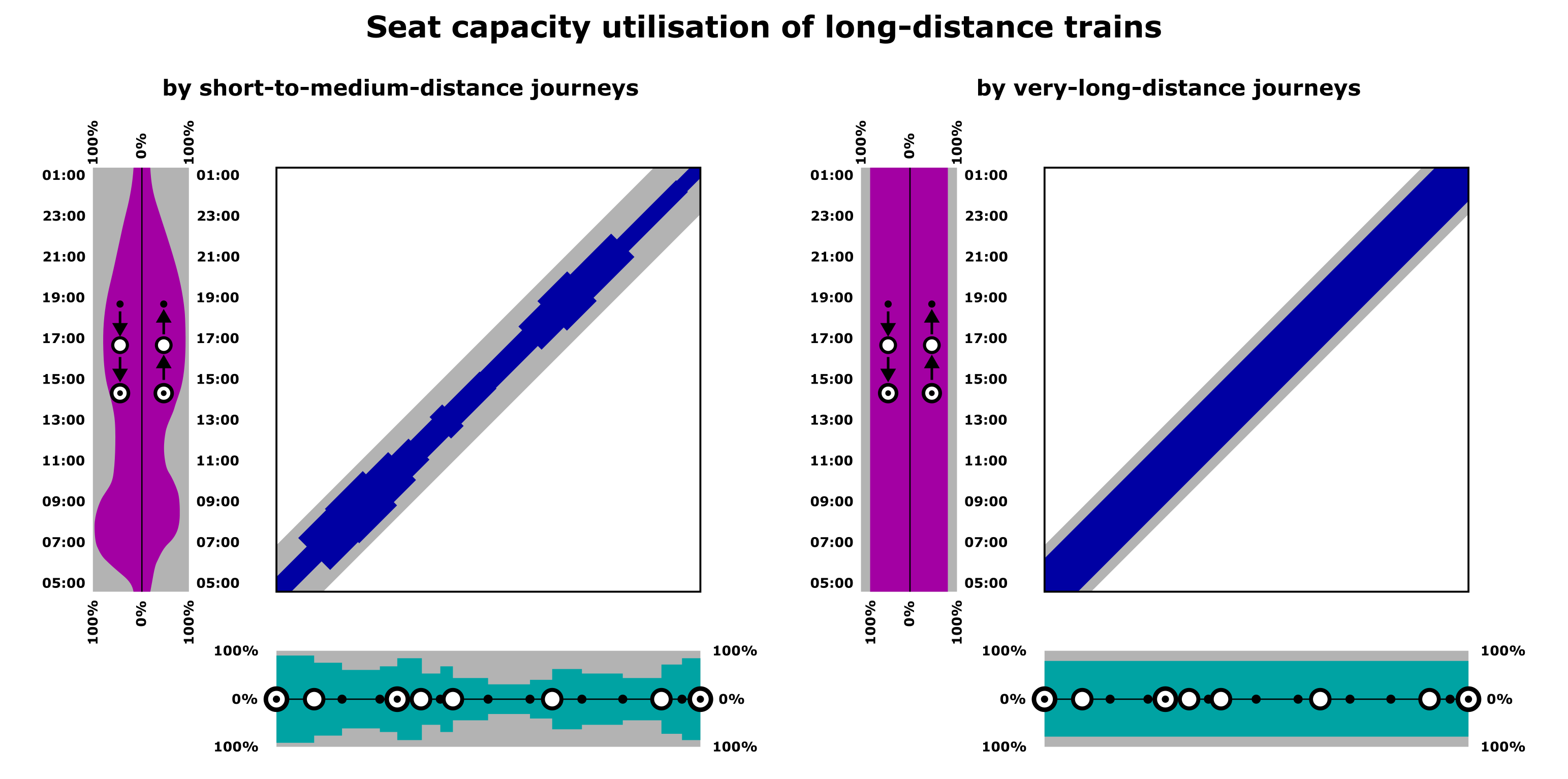
Step 1: Combination of off-peak offers by third-party or cross-operator ticketing systems
Such a system can be operated by a third-party vendor or by operators which sell tickets not only for their own trains. It is a precondition for the competitiveness of such combined long-distance tickets that operators make all their offers available for third-party vendors or ticketing systems of other operators, including the cheapest offers within their yield management schemes. In order to avoid inappropriate costs for first and last miles, the operators, authorities or transport associations responsible for local train tickets should participate as well.
In order to satisfy different target groups of different sensitivity to price, travel time, interchanges and flexibility, a ticketing system should propose a wide range of itineraries:
For passengers with higher willingness to pay, the system should offer the fastest and the most convenient connections that are as close as possible to the desired departure or arrival time. For these itineraries, both cheaper off-peak and more expensive peak offers are combined, depending on the availability of off-peak fares on the individual parts of journey.
For more price-sensitive passengers, the ticketing system should propose various congestion avoidance solutions in order to compose (nearly) the entire journey out of off-peak offers:
- temporal shift of the whole journey (e.g. from Saturday to Thursday or 11:00-23:00 instead of 7:00-19:00)
- targeted use of trains that are during peak hours on line sections of lower demand or run in counterpeak direction
- shift to a slower, but less congested route
- breaks or extended interchange times during peak time
- use of regional services where less congested than long-distance trains (e.g. in the morning peak leaving an urban agglomeration).
- combinations of these solutions
Similar to all systems selling tickets for journeys with interchanges, it must keep a balance between popular, short travel times through short interchanges on one hand and dissatisfaction of passengers plus costs for compensations in case of broken interchange connections on the other hand. In most cases, broken interchange connections can be solved at moderate costs by the use of the next train but connections involving a night train or the last train of a day should include longer transfer times.
Step 2: Specific off-peak discounts for very-long-distance trips
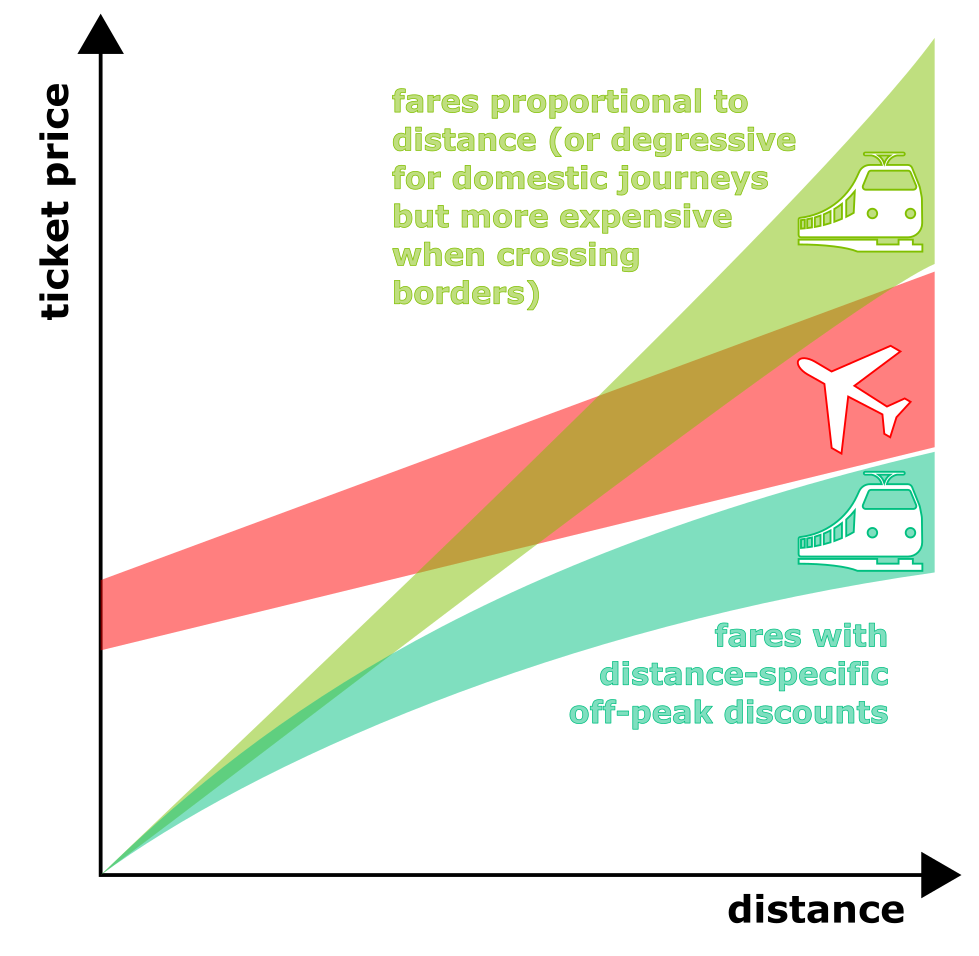
Therefore, specific off-peak discounts for very-long-distance trips would be a win-win-win situation:
- For operators: Better capacity utilization at lower risk of cannibalization
- For passengers: cheaper tickets over very-long-distance trips
- For our climate: modal shift from aviation as the most problematic mode of passenger transportation